
Meta-Para-Ontology: The Architecture of Reality Across Four Ontological Registers
https://doi.org/10.5281/zenodo.18524550
Abstract
What are the structural conditions under which any ontology becomes possible? Contemporary philosophy has produced a remarkable diversity of metaphysical systems, yet the principles governing their formation, comparison, and mutual intelligibility remain largely unexplored. Meta-Para-Ontology addresses this problem by shifting philosophical inquiry from competing descriptions of reality toward the reconstruction of the ontological prerequisites that make any description of reality possible. Its central concepts function as philosophical reconstructions of these underlying conditions of ontological articulation, remaining entirely distinct from the designation of independently existing metaphysical entities. On this basis, Meta-Para-Ontology develops a unified account of manifestation, consciousness, causality, emergence, and reflexive realization as interconnected dimensions of a single architecture. Diverse scientific theories, philosophical traditions, and religious metaphysics each occupy a distinct position within this shared topology, preserving the integrity of their conceptual architectures. The result is a framework of permanent descriptive openness: a universal coordinate system that transforms metaphysical plurality from a problem of incommensurability into a unified cartographic discipline.
Chapter 1. Introduction: The Problem Space
Contemporary philosophy has produced an extraordinary diversity of ontological systems. Materialism, idealism, process philosophy, phenomenology, scientific naturalism, classical metaphysics, and the great philosophical traditions of India each reconstruct reality through internally coherent conceptual architectures. Yet despite their sophistication, these systems continue to encounter a common methodological limitation: philosophy possesses no generally accepted framework capable of describing, comparing, and systematically localizing these systems themselves. Most ontological inquiry therefore remains directed toward a familiar question: What ultimately exists? Philosophical systems propose substances, processes, consciousness, matter, information, relations, or becoming as fundamental explanatory principles, and philosophical debate typically concerns which of these descriptions most adequately captures reality. Considerably less attention has been devoted to a more fundamental question: under what structural conditions does any ontology become possible in the first place? Before asking what reality is, philosophy may first ask how any coherent articulation of reality becomes philosophically possible.
Philosophical disagreement is frequently interpreted as mutual contradiction, obscuring the fact that competing ontologies often operate at different explanatory levels, reconstruct different domains of reality, or address fundamentally distinct philosophical problems. Scientific theories, religious metaphysics, phenomenological analyses, and classical philosophical systems consequently appear either incompatible or artificially synthesized, despite often reconstructing analogous aspects of reality through different conceptual languages. Without a universal framework capable of localizing these perspectives, philosophy lacks a principled method for determining whether apparent disagreement concerns reality itself or simply different modes of articulation. The fundamental problem therefore lies in the absence of a higher-order framework capable of rendering the existing plurality of ontological systems systematically intelligible.
Meta-Para-Ontology addresses this methodological problem by shifting philosophical investigation from the construction of ontologies toward the reconstruction of the conditions under which they themselves become possible. It seeks to identify the minimal framework through which any coherent ontological description becomes intelligible, comparable, and localizable, thereby eliminating the need to introduce another competing metaphysical doctrine. This reconstruction identifies four ontological registers—Meta-Potentiality, Formative Causality, Manifestation, and Meta-Actualization—that together constitute the minimal complete contour of reality’s articulation. These registers function exclusively as modes of localization, operating independently of the classification of entities, substances, or metaphysical domains. They identify the structural conditions through which openness, formative organization, articulated reality, and reflexive clarification become distinguishable, remaining independent of particular cosmologies, scientific paradigms, religious traditions, or metaphysical commitments.
From this foundation emerge the methodological developments presented throughout the present work. Functional Reconstruction recovers the invariant structural operations that remain concealed beneath historically contingent philosophical vocabularies; Cartographic Localization positions those reconstructed operations within the four-register framework. Collectively, these procedures establish the methodological basis for Polymetaphysics—the comparative investigation of philosophical architectures as reconstructable systems. Within this framework, philosophical worldviews become systematically comparable, fully preserving the integrity of their individual conceptual organizations. The engagement with Indian philosophy throughout the present work serves as one of the principal demonstrations of this methodology. Traditions such as \emph{Samkhya}, \emph{Vedanta}, and later evolutionary metaphysics provide particularly sophisticated philosophical systems through which the explanatory power of Meta-Para-Ontology can be demonstrated. The same framework also extends to Western philosophy, contemporary ontology, phenomenology, philosophy of mind, and future conceptual developments, providing a universal coordinate system through which diverse philosophical architectures become simultaneously distinguishable, comparable, and mutually intelligible.
Chapter 2. Methodological Commitments
The methodological commitment of Meta-Para-Ontology follows directly from the problem identified in the preceding chapter. If philosophy lacks a framework capable of comparing ontological architectures, its primary task shifts from constructing yet another ontology toward reconstructing the conditions under which ontological systems themselves become possible. Meta-Para-Ontology therefore operates as a structural ontology, identifying the fundamental modes of articulation that underlie every coherent description of reality. Moving beyond the classification of entities, substances, or metaphysical domains, it reconstructs the thresholds through which reality becomes describable in the first place. The four ontological registers consequently establish the coordinate framework within which entities, functions, processes, organizational levels, and complete systems become localizable. Their reconstruction provides the methodological foundation that renders systematic comparison possible while fully preserving the autonomy of diverse philosophical, scientific, and religious traditions. Meta-Para-Ontology supplies the higher-order architecture within which existing ontologies become mutually intelligible without sacrificing their individual conceptual integrity. This invariant four-register architecture constitutes the Register Ontology of Meta-Para-Ontology, providing the universal coordinate structure within which more specific ontological reconstructions become possible.
Within this Register Ontology, the Functional Ontology constitutes one ontological reconstruction of the register of Manifestation. The Theory of Functional Configurations of Experience (TFCE)\footcite{shapoval2026_tfce} provides the theoretical framework through which this Functional Ontology is systematically reconstructed, articulated, and analytically developed. The same architectonic foundation also supports the Theory of Emergent Metric Tension in Causality (TEMTC),\footcite{shapoval2026_temtc} which reconstructs the metric-causal dynamics originating within Formative Causality and applies the same underlying ontological architecture to the interpretation of General Relativity and Quantum Mechanics without modifying their formal scientific content. Although directed toward different philosophical problems, TFCE and TEMTC remain structurally complementary theoretical developments of Meta-Para-Ontology and are presented as separate essays accompanying the present work. Concrete entities, organizational levels, historical processes, and functional configurations consequently appear as localized articulations within an invariant ontological framework whose internal coordinate organization remains unchanged across every domain of inquiry. By combining architectonic completeness with permanent descriptive openness, Meta-Para-Ontology provides a universal system of ontological coordinates capable of localizing classical philosophical systems, contemporary scientific theories, psychological models, religious metaphysics, and future conceptual developments within one coherent topological architecture.
Chapter 3. The Four Ontological Registers
Meta-Para-Ontology reconstructs four invariant ontological registers constituting the minimal framework through which reality becomes intelligible across every domain of inquiry. These registers operate independently of the classification of entities, worlds, metaphysical substances, or particular cosmological commitments. Their exclusive function is to localize the modes of articulation through which openness, formative organization, manifestation, and reflexive clarification become distinguishable. Scientific theories, philosophical systems, religious metaphysics, and experiential frameworks each reconstruct different domains of reality and frequently employ incompatible conceptual vocabularies. Nevertheless, the four ontological registers remain invariant across every such reconstruction, providing the coordinate system through which these diverse descriptions become simultaneously localizable, comparable, and systematically intelligible. Their invariance therefore concerns the conditions under which philosophical articulation itself becomes possible rather than the contingent forms through which reality becomes articulated.
Together, Meta-Potentiality, Formative Causality, Manifestation, and Meta-Actualization constitute the minimal complete contour of articulation. Each register performs an irreducible structural function whose explanatory role cannot be derived from the others without diminishing the completeness of the framework. Their relationship is one of structural coordination, operating independently of hierarchical ordering. They identify the fundamental modes through which reality becomes articulable for philosophical investigation, entirely bypassing the classification of distinct regions of reality. Every subsequent reconstruction developed within Meta-Para-Ontology—including Functional Reconstruction, Cartographic Localization, TFCE, and TEMTC—presupposes this four-register architecture as its invariant ontological foundation.
3.1 Meta-Potentiality
Meta-Potentiality designates the invariant ontological register localizing the openness preceding every determinate articulation. Superseding descriptions of an unmanifest world, a repository of latent entities, or a collection of unrealized possibilities, Meta-Potentiality identifies the condition through which every determinate structure becomes possible while itself remaining entirely free from determination. Because every articulated organization already presupposes differentiation, causality, persistence, memory, informational structure, or relational order, none of these characteristics can belong to Meta-Potentiality itself. They emerge only after articulation has begun and belong to subsequent registers. Meta-Potentiality precedes them as the irreducible openness through which determination itself first becomes possible.
For this reason, Manifestation never exhausts Meta-Potentiality. Every determinate articulation emerges within its horizon while leaving that horizon fundamentally unchanged. Openness remains permanently non-exclusive, inexhaustible, and irreducible to every concrete realization arising within Manifestation. Eliminating this register collapses ontology into a closed system of already determined structures, extinguishing the condition under which genuinely new articulations could ever become possible. Meta-Potentiality establishes the first and indispensable ontological horizon of Meta-Para-Ontology, making every subsequent articulation conceivable without itself becoming another articulated domain among others.
3.2 Formative Causality
Formative Causality designates the ontological register localizing the formative organization through which openness becomes capable of determinate articulation. Operating as a pre-manifest matrix situated between Meta-Potentiality and Manifestation, it reconstructs the field through which determinate structures acquire coherent configuration prior to their resolution into manifestation. At this formative threshold, openness becomes progressively constrained through relational differentiation, informational persistence, and formative continuity. Causal tendencies, structural dispositions, and organizational constraints become coordinated without yet constituting concrete manifestations. Every manifestation subsequently contributes new determinations to this formative field. Each articulated configuration becomes integrated as an informational constraint influencing future possibilities of articulation, allowing previous articulations to participate continuously in the emergence of subsequent ones. Formative Causality preserves the continuity of becoming, maintaining the recursive structuring through which determination acquires coherence across the entire developmental architecture of Manifestation.
This recursive structuring remains invariant across every organizational level. Physical regularities, biological development, cognitive development, cultural evolution, and cosmological processes each reconstruct distinct expressions of the same formative operation, differing only in the complexity of their configurations. Manifestation continuously unfolds through Formative Causality, while every manifested configuration simultaneously influences the formative organization governing subsequent manifestations, preserving the continuous reciprocity between formative organization and articulated reality. Without this register, ontology would retain openness and manifestation at the expense of the continuity through which determinate structures acquire coherent articulation, preserved constraints, recursive development, and the cumulative architecture of becoming.
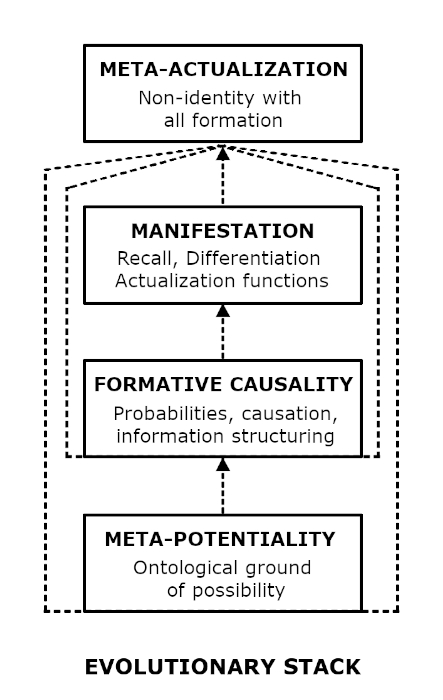
3.3 Manifestation
Manifestation designates the ontological register of articulated reality itself. Within this register, the formative organization reconstructed in Formative Causality becomes determinate configurations, events, relations, and processes. Manifestation is the register in which articulation acquires observable, measurable, and historically situated expression, remaining continuously grounded in the deeper formative matrix from which it emerges. Formative Causality and Manifestation represent two inseparable aspects of one coherent architecture. Formative Causality localizes the formative conditions through which determinate articulation becomes possible; Manifestation localizes the articulated reality through which those conditions become observable as concrete events, relations, configurations, and developmental processes. Structural tendencies appear as configurations, relational differentiation becomes interaction, and preserved informational constraints become historically situated forms of becoming. Manifestation constitutes the register in which that underlying formative matrix becomes explicitly articulated as reality itself.
Manifestation remains inseparable from the observational pole constituted by Involved Consciousness. This relation establishes the transcendental condition under which articulated reality becomes experience. Consciousness occupies the position of the witnessing condition, allowing Manifestation to unfold according to its own functional dynamics. Manifestation designates reality precisely as it becomes present for consciousness, thereby constituting experiential presence. Functional Reconstruction reveals analogous articulations of this observational relation across multiple philosophical and scientific traditions. Quantum theory reconstructs it through the inseparability of observation and measurement; psychology reconstructs it through the experiencing subject; Samkhya reconstructs it through Purusha as the witnessing principle. Transcending their profound differences in conceptual vocabulary and metaphysical commitment, each of these traditions identifies an analogous observational pole through which Manifestation becomes experience.
The internal functional structure of this register is reconstructed by the Theory of Functional Configurations of Experience (TFCE). The Differentiation Function generates the Spatial Axis through relational distinction, the Recall Function generates the Temporal Axis through continuity and persistence, and the Actualization Function generates the Evolutionary Axis through the continual emergence of progressively richer configurations. These Ontological Axes arise directly from the three Functions of Manifestation, providing the internal order through which articulated reality acquires coherence across every domain of inquiry. Manifestation occupies its place within the continuous architecture established by the four registers. Meta-Potentiality localizes openness, Formative Causality localizes formative organization, Manifestation localizes articulated reality, and Meta-Actualization localizes the reflexive clarification through which Involved Consciousness recognizes its irreducibility to the functional dynamics of Manifestation. These registers constitute the complete framework through which reality becomes intelligible. Within this architecture, Manifestation performs the unique function of presenting articulated reality itself. Without this register, the transition from formative organization to articulated reality would never occur. Entities, events, relations, and experience would therefore remain unmanifested despite the continued possibility of openness and formative organization.
3.4 Meta-Actualization
Meta-Actualization designates the final mode of localization through which Involved Consciousness becomes reflexively distinguishable from the functional dynamics of Manifestation, remaining entirely within the same field. Operating with strict immanence, it introduces no transition into a separate metaphysical realm. It discloses the witnessing principle through which the structures of Manifestation become transparent without altering the experiential field itself. Meta-Actualization clarifies the relation between Consciousness and Manifestation without transforming reality. Within the architecture of Meta-Para-Ontology, this register completes the fourfold framework by introducing its final mode of localization. Meta-Potentiality corresponds to the openness preceding determination; Formative Causality to the formative organization through which determination becomes possible; Manifestation to the articulated structures of observable reality; and Meta-Actualization to the reflexive position from which Involved Consciousness recognizes its irreducibility to every functional configuration generated through the Recall (R), Differentiation (D), and Actualization (A) Functions. The distinction centers exclusively on different modes through which one and the same field becomes localized. Meta-Actualization introduces no additional region of reality. It completes the fourfold architecture by revealing the final perspective from which the existing field becomes reflexively intelligible.
The four ontological registers operate as concurrent modes of localization within one unified topology. Their relationship does not require that every phenomenon be reconstructed through all four registers simultaneously. Each register becomes relevant whenever the corresponding mode of articulation is present within the phenomenon under investigation. Some configurations require localization through a single register, others through several at once, and highly integrated forms of conscious experience may become reconstructable through the complete four-register architecture. Manifestation presents the articulated structures of experience; Meta-Actualization reveals the witnessing position from which those same structures become reflexively transparent. The registers function as complementary perspectives on one coherent field.
This mode of localization finds recognizable structural analogues across several philosophical traditions. In Samkhya, it parallels the realization of Purusha, through which consciousness becomes distinguishable from the functional activity of prakriti. In Roberto Assagioli’s psychosynthesis, it corresponds to the distinction between the personal self and the Transpersonal Self disclosed through the practice of disidentification. In Fichte’s early idealism, it resembles the progressive clarification of the relation between the Individual Self and the Absolute Self. These traditions differ substantially in their conceptual vocabularies and metaphysical commitments, yet Functional Reconstruction reveals the same underlying operation throughout them: the dissolution of misidentification through which consciousness ceases to identify itself with the functional structures organizing experience. The orientation toward Meta-Actualization operates independently of predetermined developmental endpoints or externally imposed teleologies. The clarification it introduces proceeds through the dissolution of misidentification, distinct from the accumulation or perfection of form. The Actualization Function continues to organize Manifestation independently of whether Meta-Actualization is presently operative as a mode of localization. Only the mode of self-relation changes. Consciousness remains fully engaged within the manifested order, no longer identifying itself with the functional outputs generated by that order.
Meta-Actualization constitutes the final mode of localization available within ontology itself. Its trajectory culminates at the Trans-Ontological Horizon, remaining entirely inside the ontological field. The Trans-Ontological Horizon cannot be incorporated either as a fifth register or as an extension of the existing coordinate framework. It identifies the precise point at which every legitimate mode of articulation—including Meta-Actualization itself—reaches its principled limit. Beyond this horizon, determination, conceptual articulation, and epistemological description cease to possess methodological applicability. By introducing this final mode of localization, Meta-Para-Ontology preserves the integrity of the entire framework, avoiding both reductive naturalism and speculative metaphysical inflation. Scientific, philosophical, psychological, and religious systems remain fully localizable within the shared topology; concepts whose intended reference extends beyond the limits of articulation belong to the trans-ontological domain. The four-register architecture reaches completion through Meta-Actualization because the framework acquires the capacity to localize its own boundary from within. No additional external register is required to define that limit. Meta-Actualization stands as the final coordinate immediately preceding the Trans-Ontological Horizon, completing the architectonic unity of Meta-Para-Ontology.
3.5 The Invariance of the Four Registers
Reality may be investigated through many complementary perspectives. Scientific disciplines describe processes, philosophy reconstructs structures of reality, psychology analyzes modes of experience, and historical or evolutionary approaches investigate developmental sequences unfolding through time. Meta-Para-Ontology operates at a different methodological level. Bypassing the reconstruction of any particular domain of reality, it identifies the structural conditions that make every ontological description possible, independently of the discipline, explanatory vocabulary, or conceptual framework employed.
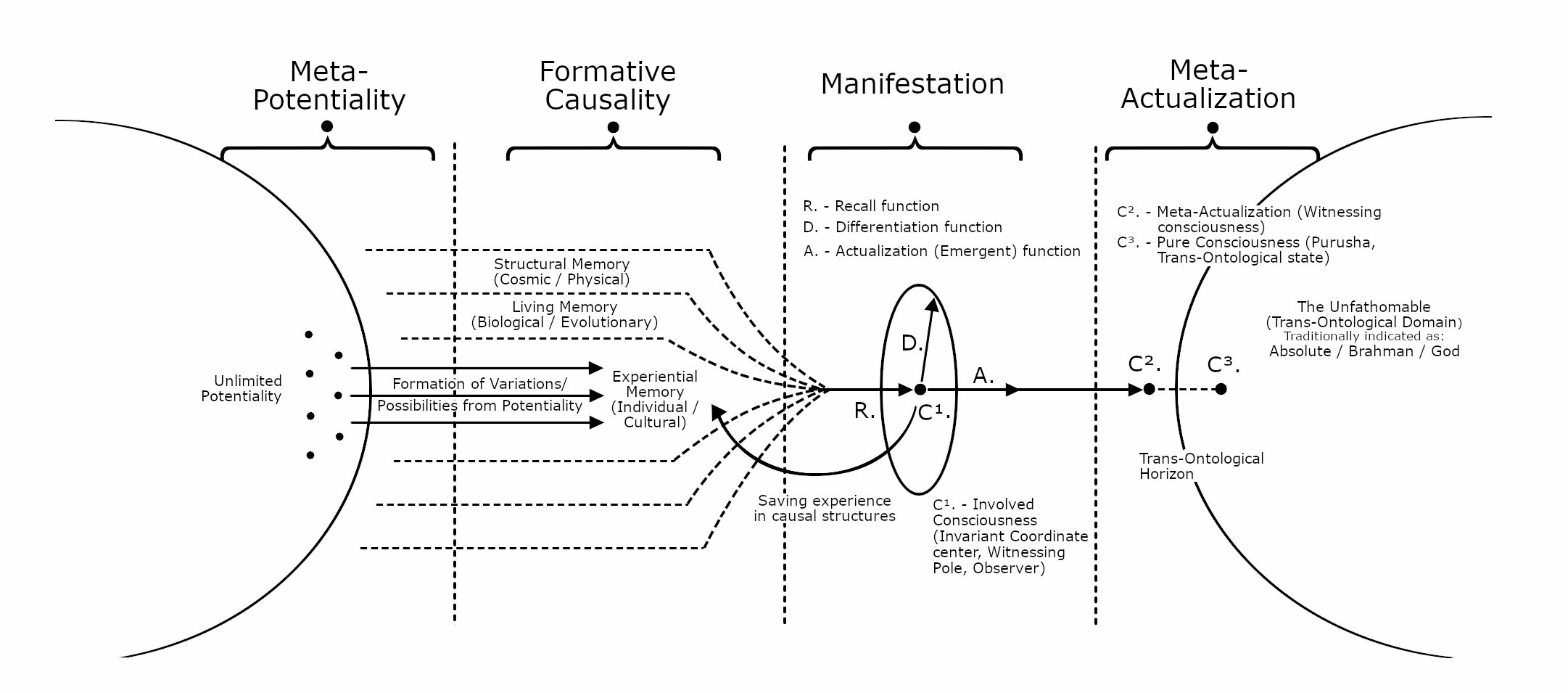
The four ontological registers therefore function as invariant modes of localization applicable whenever the corresponding conditions become relevant. They do not divide reality into isolated regions, nor do they prescribe a universal developmental sequence through which every phenomenon must unfold. Their applicability depends entirely upon the aspect of reality undergoing investigation. A single phenomenon may consequently require localization through one register, several registers simultaneously, or the complete four-register architecture. A physical object considered exclusively as an observable entity may be localized within Manifestation alone. The same object, investigated through its formative organization or developmental emergence, simultaneously engages Formative Causality. Reflective human experience provides the clearest illustration of concurrent localization. Every conscious experience unfolds within Manifestation, remains continuously conditioned by Formative Causality, preserves openness through Meta-Potentiality, and may, under conditions of reflexive clarification, become localizable through Meta-Actualization. The four registers therefore articulate distinct dimensions of one coherent field, providing complementary modes of localization without partitioning reality into separate domains.
Their invariance emerges through regressive philosophical analysis, establishing structural necessity beyond mere methodological preference. Each register identifies an irreducible mode of articulation whose absence leaves a corresponding aspect of reality without coherent localization. Meta-Potentiality localizes openness prior to determination. Formative Causality localizes the emergence of formative organization. Manifestation localizes articulated reality itself. Meta-Actualization localizes the witnessing position from which the functional organization of Manifestation becomes reflexively transparent. Together these four modes constitute the minimal complete framework required for coherent localization.
This structural minimality simultaneously preserves complete descriptive flexibility. Additional intermediate distinctions, developmental stages, or specialized subdivisions remain entirely legitimate whenever greater analytical resolution becomes necessary. Such refinements increase descriptive precision without introducing fundamentally new modes of articulation. A genuinely additional register would require demonstrating an irreducible mode of localization that cannot already be accommodated within the existing four-register architecture. The burden of justification therefore rests upon establishing the necessity of such a new articulation, independently of any obligation to preserve the number four itself.
The same principle applies in the opposite direction. Eliminating any one of the registers produces a characteristic reduction in explanatory scope. Without Meta-Potentiality, ontology loses its openness and collapses into closed determination. Without Formative Causality, no coherent account remains of how determinate organization emerges. Without Manifestation, articulated reality itself disappears from the coordinate framework. Without Meta-Actualization, ontology possesses no localization of the witnessing principle through which Manifestation becomes reflexively transparent. Each resulting reduction closely resembles historically recognizable forms of reductionism, privileging particular modes of articulation while leaving others without systematic localization.
The four-register architecture emerges through the systematic reconstruction of the minimal conditions required for ontology itself. It provides the smallest invariant coordinate framework capable of supporting coherent localization across scientific disciplines, philosophical systems, psychological theories, and religious metaphysics alike. Every tradition remains free to articulate reality through its own conceptual language, explanatory aims, and methodological commitments. Meta-Para-Ontology supplies the common topology within which these diverse articulations become simultaneously localizable, comparable, and mutually intelligible.
Chapter 4. Consciousness and the Theory of Functional Configurations of Experience
The relationship between Consciousness and Manifestation occupies a foundational position within Meta-Para-Ontology and requires careful methodological clarification. Like every central concept employed by MPO, both Pure Consciousness and Involved Consciousness function as philosophical reconstructions, entirely distinct from designations of independently existing metaphysical entities. Their purpose is to reconstruct the structural conditions under which Manifestation becomes intelligible. Within this reconstructive framework, Pure Consciousness designates the trans-ontological principle rendering every articulation of reality possible, remaining entirely independent of the metric organization of Manifestation. Accordingly, it is irreducible to classification as an entity, faculty, substance, or causal force, corresponding closely to the classical Samkhya conception of Purusha understood as the transcendental condition of manifestation. Involved Consciousness designates the structural articulation of that same trans-ontological principle relative to Manifestation. The distinction concerns two complementary modes of philosophical reconstruction, operating independently of any classification of different forms or states of consciousness. The relationship between Consciousness and Manifestation operates entirely beyond the framework of interacting domains or substances, becoming reconstructable exclusively through the functional organization by which Manifestation itself acquires intelligible structure.
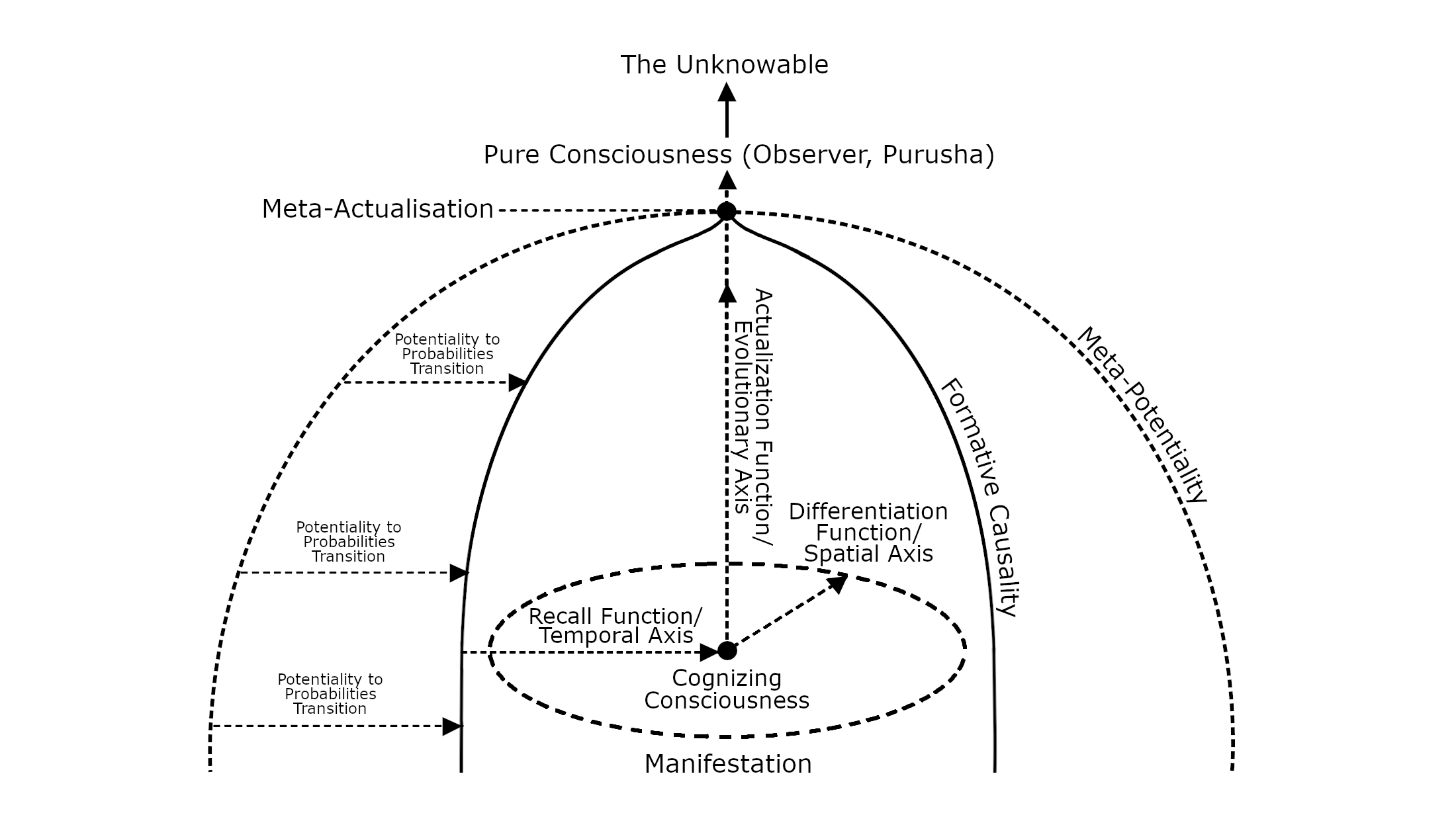
The Theory of Functional Configurations of Experience (TFCE) identifies, through regressive structural analysis, three invariant Functions by which every articulated domain of Manifestation becomes systematically intelligible: the Recall Function (R), the Differentiation Function (D), and the Actualization Function (A). Together these constitute the minimal reconstructive framework through which the continuity, articulation, and developmental orientation of experience become explainable. Functional Reconstruction demonstrates that every articulated experience becomes structurally intelligible through the coordinated operation of these three Functions. Recall reconstructs the conditions of continuity, persistence, and lawful regularity underlying temporal coherence. Differentiation reconstructs the articulation of distinctions through which Manifestation acquires relational structure, multiplicity, and spatial extension. Actualization reconstructs the orientational vector through which progressively richer functional configurations become possible, ultimately providing the conditions under which reflective clarification may arise. These Functions identify invariant structural conditions reconstructable across every level of Manifestation. Evolution continually transforms their proportional configuration without modifying the Functions themselves, allowing progressively richer forms of articulation to emerge within one continuous functional architecture. Functional Reconstruction reveals a unified explanatory framework governing the stability of physical systems, the emergence of biological complexity, the development of cognition, and the progressive refinement of reflective consciousness. The Functions operate independently of designation as causal agencies or metaphysical principles, reconstructing the minimal structural conditions through which Manifestation becomes systematically intelligible.
Against this functional background, the observational pole reconstructed as Involved Consciousness remains entirely distinct from the functional dynamics of Manifestation. It operates independently of directing or modifying the causal activity reconstructed through Recall, Differentiation, and Actualization. These Functions fully account for the structure, continuity, and transformation of Manifestation according to the metric structure originating within Formative Causality. Involved Consciousness designates the invariant observational articulation through which this functional activity becomes experience at all. Functional Reconstruction distinguishes two architectonically irreducible explanatory domains. The Functions of Manifestation reconstruct the articulation, continuity, and transformation of experience; Consciousness reconstructs the transcendental condition through which this entire functional architecture becomes experientially present. From this perspective, the Ontological Axes of Manifestation emerge as direct expressions of the same functional architecture. Space becomes reconstructable through Differentiation as the articulation of relational distinctions, Time through Recall as the persistence of organized configurations, and Evolution through Actualization as the orientational vector governing progressively richer structural complexity. These constitute the Ontological Axes of Manifestation formally reconstructed within TFCE.
The complementary Theory of Emergent Metric Tension in Causality (TEMTC) reconstructs the deeper origin of these same axes within Formative Causality, where metric tensions and informational constraints precede their crystallization into the articulated structures of Manifestation. TFCE and TEMTC constitute complementary levels of one explanatory architecture. The former reconstructs the functional dynamics through which Manifestation becomes experientially articulated; the latter reconstructs the deeper causal organization from which those functional structures emerge. The relationship between Consciousness and Manifestation can then be reconstructed with greater precision. Pure Consciousness designates the trans-ontological principle rendering articulation possible, remaining entirely independent of the spatial, temporal, and evolutionary metrics generated within Manifestation. Involved Consciousness designates the structural articulation of that same principle relative to Manifestation as the invariant observational pole through which articulated reality becomes experientially present. Meta-Actualization identifies the reflexive clarification through which identification with the functional organization of Recall, Differentiation, and Actualization progressively dissolves, preserving the functional dynamics of Manifestation entirely unchanged. The transformation concerns the mode of identification, leaving the architecture of Manifestation itself completely unaffected.
Chapter 5. Evolution and the Emergence of Levels of Organization
The emergence of organizational levels unfolds as an intrinsic dimension of the manifest order. Every level of organization is characterized by a specific proportional configuration of the three foundational Functions of Manifestation: Recall (R), Differentiation (D), and Actualization (A). These Functions remain invariant across every threshold of Manifestation, yet their proportional balance, scope of operation, and degree of integration continuously evolve. Organizational levels therefore emerge through distinct configurations of one invariant functional architecture. The Actualization Function provides the developmental orientation through which progressively new organizational levels become possible; the Differentiation Function governs the increasing richness of structural articulation within each level. At simpler stages of organization, Differentiation supports only limited structural variation, Actualization operates within a relatively narrow developmental range, and Recall preserves continuity through comparatively rigid regularities. As complexity increases, Differentiation enables increasingly rich relational architectures, Actualization continually expands the possibility of genuinely new developmental thresholds, and Recall correspondingly acquires greater flexibility, preserving continuity without rigid determinism.
Functional variability unfolds entirely within the invariant functional architecture established by Meta-Para-Ontology. The four ontological registers—Meta-Potentiality, Formative Causality, Manifestation, and Meta-Actualization—remain unchanged throughout every developmental transformation. They localize the conditions of openness, formative organization, articulated reality, and reflexive clarification through which any universe, world, or domain of experience becomes possible. Organizational levels therefore constitute variable configurations arising within Manifestation, remaining entirely distinct from the registers themselves. Every level corresponds to a distinct proportional configuration of Recall, Differentiation, and Actualization, and evolution proceeds through the continual reconfiguration of this functional equilibrium. The Evolutionary Axis, grounded directly in the Actualization Function, consequently localizes the succession of developmental thresholds through which Manifestation becomes capable of sustaining progressively richer modes of articulation. Its significance lies in localizing the progressive emergence of qualitatively new structural configurations within the invariant functional architecture, extending beyond the mere measurement of increasing complexity.
The same perspective also clarifies the status of every classification of organizational levels, frequently described within metaphysical traditions as planes or orders of existence. Such classifications remain necessarily provisional because Meta-Para-Ontology defines organizational levels through continuous shifts in the proportional vector R, D, A, operating independently of permanently fixed strata. Any particular hierarchy therefore functions as an analytical coordinate system rather than a final taxonomy. The framework remains compatible with multiple models of stratification, provided Consciousness is consistently understood as the transcendental condition of Manifestation, excluding any role as an efficient causal agent of evolutionary differentiation. Compatibility extends equally to metaphysical traditions and to contemporary naturalistic theories of emergence and complexity. Scientific investigation intentionally brackets the observational pole in order to examine the internal dynamics of Manifestation, preserving the full explanatory legitimacy of empirical theories within their methodological scope. Meta-Para-Ontology reconstructs the broader conditions under which those same developmental processes become intelligible. The accompanying schema (Fig. \ref{fig:levels-schema}) therefore distinguishes physical, vital, mental, and transmental domains solely as structural coordinates for phenomenological and psychological orientation. Independent philosophical convergence further supports this reconstruction. Certain aspects display affinities with Sri Aurobindo’s distinction between mental and supramental organization, including the concept of the Overmind.\footcite{aurobindo_lifedivine} Comparable structural principles similarly appear within Nicolai Hartmann’s doctrine of ontological levels (Schichtenlehre),\footcite{hartmann_levelsofreality} where progressively higher levels emerge without violating the continuity of lower-level laws. The field of Manifestation consequently remains permanently open to alternative stratifications and future descriptive refinements, provided they are reconstructed as particular proportional organizations within the invariant functional architecture.
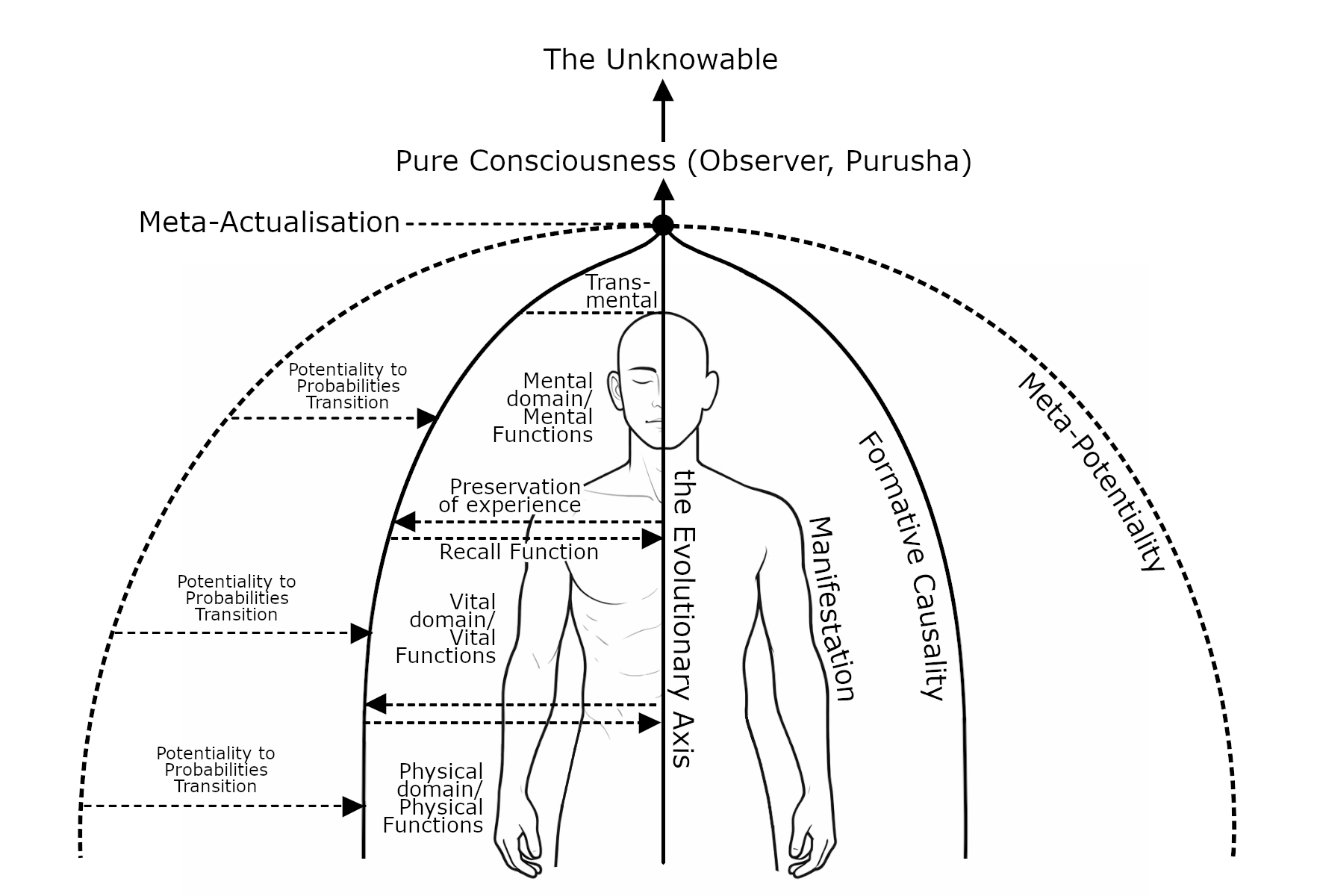
Where Consciousness becomes capable of participating in progressively richer organizational levels, Manifestation simultaneously acquires increasingly differentiated, integrated, and reflexively transparent modes of experience. Evolution expresses the continual emergence of new proportional organizations through which Manifestation sustains progressively richer forms of experiential organization, extending far beyond the mere multiplication of forms.
Chapter 6. Structural Openness and Non-Closure
Meta-Para-Ontology combines a fully specified four-register architecture with an open framework capable of accommodating indefinitely diverse domains of inquiry and experience. Such openness follows directly from its reconstructive methodology. The framework centers on reconstructing the structural conditions under which entities, relations, and modes of experience become systematically intelligible, superseding the enlargement of metaphysical inventories as its methodological objective. Its central concepts reconstruct irreducible conditions of articulation rather than expanding the inventory of metaphysical entities. The framework identifies exclusively the conditions through which every description of reality becomes possible, leaving the concrete articulation of reality fundamentally open. The four-register architecture remains invariant; the domains localized within it remain indefinitely expandable. This methodological openness is grounded in the priority of structural articulation over exhaustive metaphysical inventories. By preserving this priority, Meta-Para-Ontology establishes a coordinate framework capable of accommodating the continuing expansion of scientific knowledge, philosophical inquiry, psychological investigation, and religious reflection, permanently preserving its architectonic foundation. Completeness resides exclusively in the articulation of the conditions through which reality becomes describable, entirely independent of any exhaustive description of reality itself. Because these conditions remain invariant even as the domains they localize continue to expand indefinitely, Meta-Para-Ontology unites architectonic completeness with permanent descriptive openness.
Methodological openness naturally extends across every domain of inquiry. Because Meta-Para-Ontology operates at the level of ontological articulation itself, scientific disciplines—including physics, cosmology, biology, and evolutionary theory—coexist seamlessly with psychology, metaphysics, and religious traditions. Each preserves its own explanatory autonomy while occupying a distinct position within one coherent ontological topology. The framework operates independently of the specific explanatory methods of these disciplines, reconstructing the coordinate system through which their respective domains become simultaneously localizable and mutually intelligible. This integrative capacity finds concrete analytical expression through direct theoretical application. The principles of Meta-Para-Ontology provide the foundation for the Theory of Emergent Metric Tension in Causality (TEMTC), which applies the framework to the interpretation of quantum mechanics and the emergence of spacetime structure. Developed in detail throughout the accompanying essays of this corpus, these investigations demonstrate how scientific and metaphysical descriptions occupy distinct yet internally coherent positions within one unified explanatory architecture.
The same coordinate framework equally accommodates philosophical and religious plurality. The four ontological registers operate as invariant modes of localization independent of particular doctrinal commitments, allowing multiple interpretations of reality to coexist without compromising the integrity of the underlying architecture. Diverse philosophical traditions articulate the relation between consciousness and Manifestation through different conceptual trajectories, emphasizing knowledge, devotion, action, identity, difference, process, or dynamic interaction. Each reconstructs the same underlying articulations through its own philosophical vocabulary. Meta-Para-Ontology therefore provides a meta-structural framework within which traditions such as Samkhya, Vedanta, evolutionary philosophy, and contemporary theories of emergence become systematically comparable, fully preserving the integrity of each. These traditions illuminate different organizations of the relations between consciousness, Manifestation, individuality, and ultimate reality. Each contributes an internally coherent reconstruction of particular dimensions within the shared field.
The framework consequently remains permanently open to future discoveries precisely because its architectonic foundation is complete. Future philosophical systems, scientific theories, psychological models, and religious metaphysics require no modification of the underlying architecture. They become available for Cartographic Localization as newly reconstructed configurations within the existing coordinate framework. The task of Meta-Para-Ontology therefore lies in providing the invariant topology through which every future articulation becomes systematically localizable. Structural openness follows directly from architectonic completeness. The universality of the coordinate system guarantees the indefinite extensibility of the realities it can localize, preserving the invariant architecture while continuously expanding the range of articulations available for reconstruction.
Chapter 7. Structural Parallels with Indian Philosophical Ontologies
Classical Indian metaphysics provides one of the richest philosophical contexts through which the methodology of Meta-Para-Ontology can be demonstrated. Indian philosophy contains some of the most sophisticated attempts to articulate the relations between potentiality, manifestation, causality, consciousness, and realization. Meta-Para-Ontology approaches these achievements by reconstructing the ontological operations performed by their central concepts and localizing those operations within a common coordinate topology. Functional Reconstruction identifies the invariant articulations toward which historically situated concepts point, making them available for Cartographic Localization independently of their original vocabulary or doctrinal commitments. Historical formulations therefore remain philosophically significant because they preserve recoverable structural operations whose relevance extends beyond the traditions in which they first appeared.
This reconstructive methodology becomes particularly evident in classical systems such as Samkhya and Vedanta, both of which approach reality through layered principles beyond isolated entities or substances. Samkhya presents one of the earliest systematic reconstructions distinguishing unmanifest openness from articulated manifestation while simultaneously explaining the formative organization connecting them. Vedanta develops complementary analyses concerning consciousness, manifestation, identity, and realization. Even across substantially different metaphysical conclusions, each tradition isolates structural articulations that remain recoverable through Functional Reconstruction. The same orientation continues within later Indian philosophy, most notably in the work of Sri Aurobindo, whose evolutionary metaphysics reconstructs Manifestation as the progressive articulation of underlying principles. His attempt to understand consciousness, matter, and evolution within one unified philosophical architecture converges upon the same fundamental problem addressed by Meta-Para-Ontology: the organization of reality through formative articulation, superseding appeals to immutable metaphysical substances.
Meta-Para-Ontology reconstructs these philosophical achievements within one invariant topology, allowing their underlying operations to become systematically localizable and mutually comparable. The resulting correspondence concerns structural organization alone, remaining entirely independent of historical influence, philosophical dependence, or doctrinal continuity. Functional Reconstruction therefore extracts discipline-independent structural articulations from historically situated concepts, making analogous discoveries emerging across different civilizations directly comparable without compromising their historical individuality. This polymetaphysical methodology extends beyond Indian philosophy to encompass modern philosophy and contemporary scientific inquiry within one common coordinate system, fully preserving the methodological autonomy of every participating tradition.
From this perspective, several central concepts of classical Indian philosophy perform structural roles that display remarkable correspondence with the four-register architecture of Meta-Para-Ontology. Concepts such as Avyakta and Pradhana reconstruct an undifferentiated openness closely corresponding to Meta-Potentiality as the non-manifest condition from which determinate articulation becomes possible. Concepts such as Karma and Akasha reconstruct operations of persistence, transmission, and relational continuity through which Manifestation acquires coherent organization, revealing close affinity with Formative Causality. Likewise, notions such as the Karana Sharira and the Anandamaya Kosha reconstruct pre-phenomenal dimensions mediating between undifferentiated openness and manifest individuality. These correspondences demonstrate that philosophically independent traditions repeatedly recover the same fundamental articulations even across profoundly different conceptual languages. The primary object of Polymetaphysical Cartography therefore consists in the invariant structural operations these formulations independently preserve. Historical vocabularies remain valuable as the conceptual media through which those operations become philosophically articulated.
Conclusion
Meta-Para-Ontology articulates a unified architecture capable of preserving philosophical plurality within one coherent coordinate framework. By identifying four invariant ontological registers—Meta-Potentiality, Formative Causality, Manifestation, and Meta-Actualization—it reconstructs the minimal complete contour through which any universe, experience, or coherent description of reality becomes intelligible, leaving every concrete realization permanently open. Unity consequently emerges at the level of articulation itself, extending across doctrines, cosmologies, and soteriological traditions through one invariant topology. Evolution, differentiation, and organizational levels become reconstructable within this topology as variable configurations of Manifestation, entirely distinct from independent domains of reality. They express contingent organizations generated through the functional architecture of reality; the Evolutionary Axis grounded in the Actualization Function provides the orientational principle through which indefinitely diverse developmental trajectories become systematically localizable. Meta-Actualization completes the four-register architecture by localizing the reflexive threshold at which ontology becomes transparent to its own structural conditions and limits. This clarification unfolds entirely within the same field, preserving the continuity of the framework from Meta-Potentiality through Meta-Actualization. Structural openness therefore characterizes both the evolving organization of Manifestation and the plurality of modes through which reflexive clarification may arise.
The resulting framework combines architectonic rigor with permanent descriptive openness. Philosophical, scientific, psychological, and religious ontologies become systematically localizable, mutually comparable, and structurally intelligible within one common topology. This achievement operates independently of enlarging the metaphysical inventory. Meta-Para-Ontology reconstructs the structural conditions through which worlds, doctrines, experiences, and realizations become articulable. Its central concepts reconstruct the invariant conditions through which reality becomes intelligible. The openness of Meta-Para-Ontology follows directly from this reconstructive methodology. Every future ontological articulation consequently remains permanently open to systematic reconstruction, preserving the invariant architectonic principles of the framework while continuously increasing its explanatory resolution.
Implications and Further Work
The framework developed throughout the present work opens multiple directions for future philosophical investigation. Conceptually, it establishes the conditions for reconstructing such phenomena as misidentification, freedom, agency, error, value, and fulfillment as invariant structural articulations, making these domains available for systematic investigation alongside their established psychological, ethical, and phenomenological interpretations. Methodologically, it establishes the foundations of Polymetaphysical Cartography through the complementary procedures of Functional Reconstruction and Cartographic Localization. The same reconstructive methodology enables rigorous comparative investigation across Vedantic, Samkhya, Buddhist, Shaiva, Western philosophical, and contemporary scientific traditions. Their historical independence, methodological diversity, and conceptual integrity remain fully preserved, becoming systematically localizable within one invariant ontological topology. Functional Reconstruction thereby identifies structural articulations extending across historically independent philosophical systems, preserving their conceptual distinctiveness. The scope of the framework extends equally to contemporary philosophy of mind, theories of emergence, evolutionary cosmology, artificial intelligence, and the study of non-human cognition. Physical, biological, cognitive, and reflexive organizations become reconstructable within one coherent coordinate framework, substantially expanding the domain of comparative inquiry across every presently accessible level of organization.
The broader significance of the present work ultimately lies in establishing the foundations of a cumulative philosophical research program. Meta-Para-Ontology provides the reconstructive architecture through which ontological systems become systematically intelligible. Upon this foundation, Polymetaphysics emerges as the comparative discipline devoted to the investigation of philosophical architectures, and Polymetaphysical Cartography provides its operational methodology. As philosophical systems become reconstructable through Functional Reconstruction and localizable within the invariant topology of Meta-Para-Ontology, philosophical disagreement itself becomes amenable to structural analysis. The present work establishes the methodological and ontological foundations of an open-ended research program through which future developments in philosophy, science, psychology, and metaphysics become continuously reconstructable, mutually comparable, and systematically localizable within one coherent coordinate architecture.
Bibliography
-
Assagioli, Roberto. Psychosynthesis: Principles and Techniques. New York: Viking Press, 1965.
-
Aurobindo, Sri. The Life Divine. 1939–1940. U.S. ed.; ISBN 978-0-941524-61-2; OCLC: 1468337906. WI: Lotus Press, 1985.
-
Frank, S. L. The Unknowable: An Ontological Introduction to the Philosophy of Religion. 1939. Angelico Press, 2020.
-
Hartmann, Nicolai. Der Aufbau der realen Welt: Grundriss der allgemeinen Kategorienlehre. German edition; often cited for Hartmann’s doctrine of layers/levels of reality. Berlin: Walter de Gruyter, 1940.
-
Heisenberg, Werner. Physics and Philosophy: The Revolution in Modern Science. New York: Harper & Brothers, 1958.
-
Iśvarakṣṇa. Sāṁkhya-Kārikā. With the Tattva Kaumudī of Vācaspati Miśra and related commentarial material. Madras: Sri Ramakrishna Math, 1995.
-
Jaspers, Karl. The Perennial Scope of Philosophy (Der philosophische Glaube). New York: Philosophical Library, 1948.
-
Shapoval, Oleksandr. The Theory of Emergent Metric Tension in Causality: An Ontological Framework for Quantum Mechanics and Spacetime, 2026. https://doi.org/10.5281/zenodo.18525058
-
Shapoval, Oleksandr. The Theory of Functional Configurations of Experience: A Triadic Code of Existence, 2026. https://doi.org/10.5281/zenodo.18596219