-
Register Ontology
The Meta-System of the four invariant ontological registers.
-
Functional Ontology
The operational dynamics of Manifestation.
-
Polymetaphysics
The methodology of ontological cartography.
-
Terminology
The technical vocabulary of Meta-Para-Ontology.
Introduction
Meta-Para-Ontology (MPO) occupies a meta-level position over competing frameworks for describing reality, regarding each as a structurally valid description of the ontological domain within which it operates. It represents a fundamental shift in the organization of human knowledge: a paradigm in which every existing theory, discipline, and tradition acquires a precise place within a single coherent architecture of reality. MPO preserves the world already known. Physics remains the study of the observable world. Psychology remains the study of experience. Religious and contemplative traditions lead to the limits of phenomenological experience, pointing to a domain beyond them. Every discipline retains its own language, methods, and conclusions while becoming structurally locatable within a universal framework capable of revealing the deeper relations between apparently isolated domains. Without a unifying architecture, however, this autonomy has left human knowledge structurally fragmented. Different disciplines have achieved extraordinary precision within their own domains while remaining separated by incompatible conceptual frameworks and unexplained boundaries. Meta-Para-Ontology addresses this fragmentation by reconstructing the underlying structural conditions through which every form of knowledge becomes possible, revealing the shared territory connecting these diverse approaches and relocating each within a coherent architecture of reality.
Meta-Para-Ontology reconstructs the ontological description of reality as a single coherent Meta-System. It provides a universal coordinate framework for describing, organizing, and integrating human knowledge while preserving the conceptual integrity and methodological autonomy of every discipline and tradition. This reconstruction becomes necessary because every coherent description of reality is conditioned by the conceptual structure through which it is articulated. Different disciplines therefore illuminate different aspects of reality while remaining constrained by the explanatory scope of their own concepts. Physics describes the observable behavior of matter while operating independently of the ontological conditions that make manifestation possible. Psychology reconstructs the organization of experience while leaving unexamined the ontological ground upon which experience occurs. Contemplative traditions investigate consciousness with exceptional precision, yet their vocabulary rarely translates into empirical inquiry. The diversity of philosophical, scientific, psychological, and contemplative systems therefore reflects fundamental differences in the structural conditions under which reality becomes describable, extending far beyond mere differences of interpretation.
Bypassing the pursuit of yet another description of reality, Meta-Para-Ontology investigates the structural conditions that make every ontology possible. This makes Meta-Para-Ontology a structural ontology—more precisely, an ontology of ontologies. Its object of inquiry focuses on the universal modes through which reality becomes articulable before any discipline begins to populate that articulation with its own entities, concepts, or explanatory principles. What once appeared as competing worldviews are revealed as complementary perspectives describing different regions of one coherent Meta-System. Different philosophical systems often make incompatible claims because they describe different structures within the same register or rest on fundamentally different conceptual commitments. Meta-Para-Ontology preserves genuine disagreement while resolving a different kind of conflict: the false rivalry that emerges when disciplines operating at different ontological thresholds mistake one another for competing descriptions of the same domain.
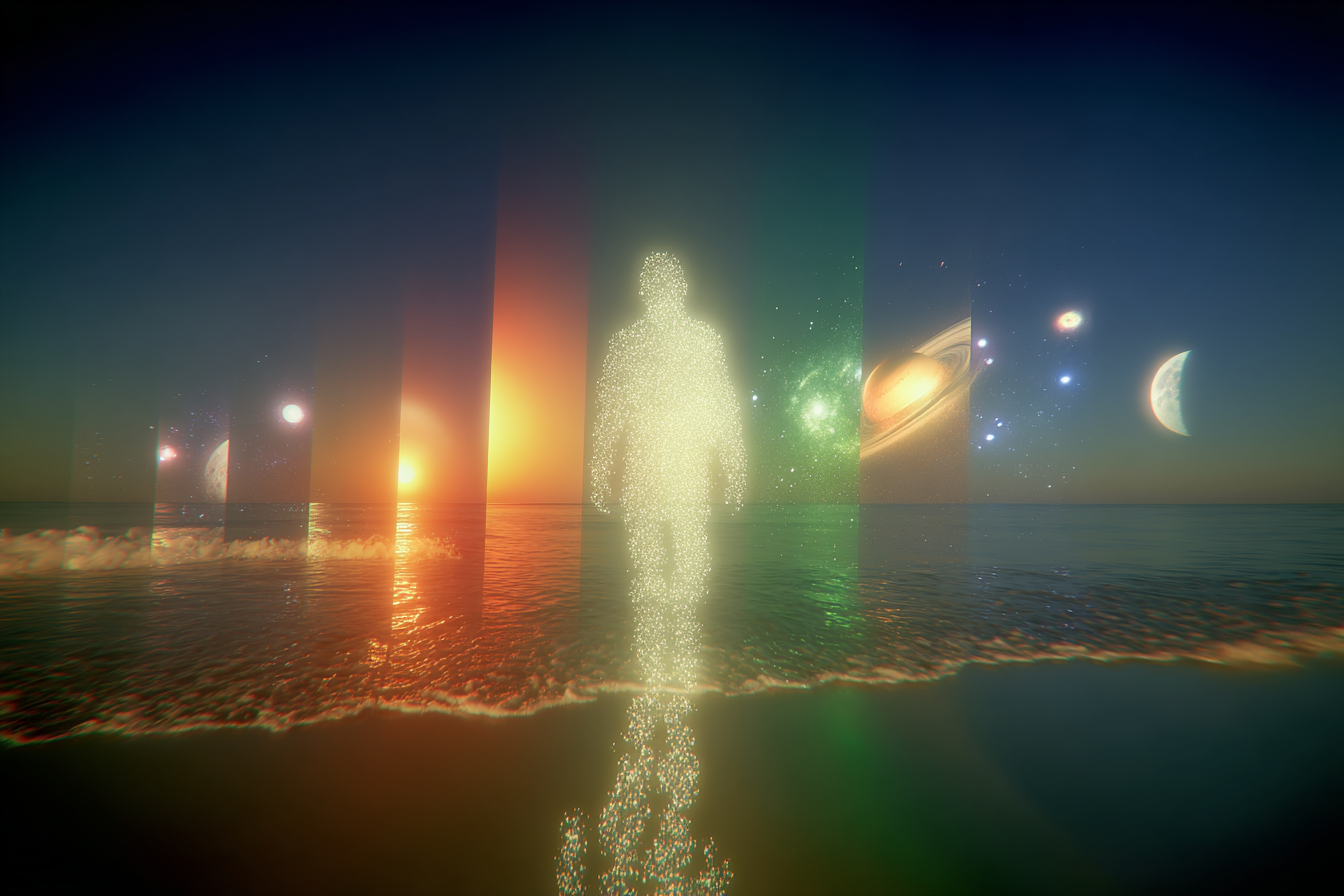
The fundamental instrument of this inquiry is the register. It functions exclusively as a structural threshold, completely distinct from any substance, realm, or temporal stage. It defines a precise coordinate at which the mode through which reality becomes intelligible changes—much like the event horizon of a black hole, which possesses no mass or material content of its own, yet defines with total precision where the laws governing one regime give way to another. Meta-Para-Ontology identifies four such invariant thresholds: Meta-Potentiality, the threshold at which determination first becomes possible; Formative Causality, the threshold at which determination stabilizes into structured tendency; Manifestation, the threshold at which structure enters experience as observable world; and Meta-Actualization, the threshold at which experience becomes reflexively available to the awareness within it. Physics, biology, psychology, and the contemplative examination of consciousness thereby appear as disciplines that become articulate at different registers, describing different phases of one continuous unfolding.
This architecture unfolds through three complementary components. Register Ontology establishes the invariant topological framework of reality by reconstructing the four ontological registers and the structural relations between them. Functional Ontology investigates the universal operational dynamics through which Manifestation continuously unfolds across every scale of existence, from cosmology and physics to biological evolution, cognition, and human experience. Polymetaphysical Cartography provides the methodological framework for locating existing philosophical systems, scientific theories, psychological models, and contemplative traditions within this shared architecture. Each discipline retains its own language, concepts, and internal logic while acquiring precise structural coordinates within a larger intelligible whole. A theory keeps its own voice; only its position on the map is ever specified.
The framework also recognizes the absolute limits of ontology itself. Beyond the horizon of Meta-Actualization lies a domain exceeding the reach of conceptual determination. Identifying this boundary as an intrinsic structural limit, Meta-Para-Ontology leaves what exceeds it to the symbolic, apophatic, and contemplative modes of inquiry that have always served as the proper instruments for approaching it. Meta-Para-Ontology is therefore best understood as a universal structural coordinate system for the disciplines that already investigate reality. Its architecture remains invariant while the knowledge mapped within it remains indefinitely expandable: every new philosophy, scientific theory, or contemplative tradition finds its coordinates without requiring the framework itself to be reconstructed. In this sense, Meta-Para-Ontology offers a permanent cartography of human knowledge—one that preserves coherence without reduction and openness without sacrificing structural precision.
Across a growing body of academic work, this architecture has been applied to questions concerning space and time, evolution, memory, causality, cosmology, consciousness, and the outer limits of philosophy itself. In one dedicated study, Meta-Para-Ontology identifies the exact ontological root of the persistent mathematical conflict between quantum mechanics and general relativity. Beyond this scientific application, it establishes a rigorous foundation for dialogue between religious and contemplative traditions, grounding their often metaphorical metaphysical insights in structural knowledge. Where materialism and metaphysics spent centuries demanding mutual surrender, MPO constructs a logical bridge, establishing that their coexistence is a structural necessity.
Meta-Para-Ontology transforms fragmented domains of knowledge into a precise coordinate system—the structural space through which every science, every tradition, and every unresolved question acquires its proper ontological location.
It is the map of reality’s own harmony.