
The Theory of Emergent Metric Tension in Causality: An Ontological Framework for Quantum Mechanics and Spacetime
https://doi.org/10.5281/zenodo.18525058
Abstract
This paper introduces the Theory of Emergent Metric Tension in Causality (TEMTC), grounded in the ontological architecture of Meta-Para-Ontology, as a meta-structural framework for interpreting the conceptual divide between quantum mechanics and general relativity. By situating physical phenomena within a broader coordinate framework, TEMTC interprets spacetime geometry, gravitational dynamics, and quantum behavior as emergent expressions of a deeper causal organization. Causality functions as a field of relational constraints whose internal tensions manifest as physical phenomena. Space and time arise at the threshold of Manifestation as relational forms through which this relational network becomes accessible to observation, such that gravitational dynamics express the stabilization and systemic coherence of these underlying relations. By prioritizing this shared coordinate architecture, TEMTC uncovers the root of their incompatibility as a problem of ontological interpretation—requiring no alternative mathematical formalism—thereby preserving the formal integrity of each physical paradigm.
Introduction
Modern physics, despite its extraordinary success in both quantum mechanics (QM) and general relativity (GR), continues to face a persistent foundational problem: the absence of a coherent conceptual framework capable of unifying these two theories. Each describes reality with remarkable precision within its own domain, yet they rest on fundamentally incompatible assumptions concerning time, causality, and physical structure. The difficulty therefore extends beyond mathematical unification toward the deeper question of how these theories should be situated within a common ontological architecture.
Standard quantum mechanics operates upon a fixed background, treating space and time as pre-given parameters within which particles and fields evolve. Formulated within a probabilistic framework, it relies inherently on the measurement process and validates non-classical correlations that resist localization within ordinary spatial boundaries. General relativity describes gravity through the geometry of spacetime, defining spacetime as a dynamic structure shaped continuously by mass and energy \footcite{Einstein1916}. Its field equations determine the deterministic evolution of this geometry from initial conditions, assigning no specialized or privileged role to an observer.
This divergence extends beyond mathematical formalism into the foundational assumptions governing each theory. Quantum mechanics presupposes a spacetime framework within which events occur; general relativity reconstructs spacetime itself as a consequence of physical relations. Quantum theory employs an external temporal parameter to describe state transitions; general relativity incorporates time directly into spacetime geometry. Quantum outcomes appear probabilistic and contextual; general relativity describes deterministic geometric evolution. These differences indicate that the two theories describe distinct aspects of reality from different ontological positions. Both nevertheless remain empirically successful within their respective domains.
Attempts to reconcile these frameworks have consistently encountered this foundational tension. Applying standard quantum field theoretic methods to gravitation yields a non-renormalizable framework incapable of producing stable predictive results \footcite{tHooftVeltman1974,GoroffSagnotti1986}. This mathematical breakdown suggests that the incompatibility extends into the conceptual assumptions underlying the two theories themselves. Quantum theory requires an invariant background metric together with an external temporal parameter; general relativity establishes spacetime as an inherently dynamical and emergent structure. Standard approaches such as String Theory seek to overcome this incompatibility through mathematical unification; Loop Quantum Gravity reconstructs spacetime through an alternative physical description. Both approaches nevertheless remain entirely situated within the physical domain. TEMTC interprets these mathematical and structural tensions as expressions of a deeper level of causal organization whose reconstruction belongs to ontology rather than physics.
Interpreted through the ontological architecture of TEMTC, the persistent tension reflects a structural limit within contemporary physical paradigms. Traditional physical frameworks describe spacetime geometry and causal dynamics as belonging to a single metric level. Meta-Para-Ontology renders this distinction explicit by localizing spacetime geometry and quantum behavior as differentiated emergent thresholds arising from one continuous causal organization. The apparent incompatibility consequently reflects the coexistence of distinct structural thresholds within a common ontological architecture. TEMTC correspondingly reconstructs the ontological conditions under which both spacetime geometry and quantum behavior become intelligible as differentiated manifestations of a single causal continuum. Entities commonly treated by physics as fundamental consequently appear as emergent structural thresholds localized within a deeper ontological organization.
Methodologically, TEMTC is developed as an ontological interpretation situated within the coordinate architecture of Meta-Para-Ontology. The empirical content, mathematical apparatus, and explanatory integrity of contemporary physics remain entirely preserved. Because existing physical formalisms already describe their respective empirical domains with extraordinary precision, constructing an alternative mathematical formalism lies beyond the scope of the present investigation. The objective of TEMTC is ontological integration: to provide the structural coordinates through which the conceptual relation between quantum mechanics and general relativity becomes intelligible. Physical theories reconstruct the organization of manifested reality once their fundamental categories have been established. Ontological reconstruction instead identifies the conditions under which those categories themselves become possible. Throughout the present study, reconstruction denotes the identification of ontological conditions, operating independently of physical derivation, causal production, or mathematical explanation. The present investigation therefore belongs to the domain of ontological analysis, distinct from theoretical physics. Its adequacy is evaluated according to criteria appropriate to ontological inquiry: internal architectural coherence, conceptual consistency, explanatory integration, and the capacity to localize existing physical theories within a common coordinate framework while preserving both their mathematical formalisms and empirical validity. Questions concerning predictive mathematical models or experimental verification remain the responsibility of the physical theories whose empirical integrity TEMTC explicitly preserves.
TEMTC consequently investigates quantum mechanics and general relativity as complementary localizations within one continuous causal architecture. Physics thereby becomes the object of ontological localization; ontology in turn establishes the coordinate framework through which these physical theories become mutually intelligible. Both quantum mechanics and general relativity are understood to presuppose a level of causal organization that neither theory explicitly describes. At this level, categories commonly treated as fundamental—including space, time, matter, causality, and probability—appear as derivative articulations emerging from pre-geometric and non-material conditions. This perspective requires a framework that begins from the conditions under which structured reality becomes possible without presupposing spacetime, particles, or fields as its primary explanatory basis. Situated within the architectural registers of Meta-Para-Ontology, the Theory of Emergent Metric Tension in Causality (TEMTC) provides such a framework by interpreting reality as fundamentally organized through causal continuity from which metric geometry emerges. The causal field preserves the relational continuity conditioning subsequent manifestations; time crystallizes through ordered differentiation; informational persistence arises as an intrinsic feature of this causal organization. Causal organization therefore precedes spacetime, providing the continuity through which manifested events become possible. Determination emerges through relational tension within an evolving causal field whose observable articulation constitutes Manifestation. The apparent incompatibility between quantum mechanics and general relativity thus reflects two distinct emergent expressions of one continuous causal organization. TEMTC reconstructs this shared causal foundation, establishing causality as the primary organizing principle through which both spacetime geometry and quantum behavior become mutually intelligible.
Chapter 1. Register Ontology
The Theory of Emergent Metric Tension in Causality (TEMTC), developed within the framework of Meta-Para-Ontology,\footcite{shapoval2026_metaparaontology} establishes a non-reductive ontological architecture for interpreting the structural tension between quantum mechanics and general relativity. By situating contemporary physics within a broader coordinate framework, TEMTC clarifies the conditions underlying both theories. Meta-Para-Ontology itself operates as a meta-level reconstructive methodology. Bypassing the enlargement of ontological inventories, it reconstructs the structural conditions under which ontological entities, relations, and modes of experience become systematically intelligible. Its central concepts therefore function as ontological registrations of irreducible structural articulations, entirely distinct from independently existing metaphysical objects or substances. Against this reconstructive background, TEMTC operates strictly as an ontological interpretation. Whereas the Theory of Functional Configurations of Experience (TFCE)\footcite{shapoval2026_tfce} reconstructs the invariant functional organization of Manifestation through the Functional Ontology, TEMTC examines the underlying metric-causal dynamics through which this functional organization becomes operational. The two theories therefore describe complementary aspects of the same Functional Ontology, rather than introducing a separate ontological register or an independent domain of reconstruction.
Since the present investigation interprets quantum and relativistic physics through the coordinate architecture of Meta-Para-Ontology, a minimal presentation of that architecture is required before its ontological reconstruction can begin. The following overview therefore introduces only those elements of the Register Ontology necessary for the ontological reconstruction developed in the present essay. The coordinate architecture of Meta-Para-Ontology is organized through four primary registers representing the fundamental transitions through which structured reality becomes possible:
- Meta-Potentiality
- Formative Causality
- Manifestation
- Meta-Actualization
The four registers constitute invariant coordinates through which every structured reality becomes articulable, operating entirely beyond the representation of separate ontological regions. Their architectural coherence remains constant across physical, biological, psychological, cosmological, and metaphysical domains, independently of the particular structures emerging within them. They function as ontological registrations of irreducible modes of structural articulation, entirely distinct from independently existing ontological domains. Together they reconstruct the successive structural conditions through which relational articulation, metric emergence, and physical manifestation become systematically intelligible, providing the stable architectonic framework within which every subsequent configuration becomes localizable.
Meta-Actualization completes the four-register architecture of Meta-Para-Ontology. The present investigation focuses exclusively on the first three registers, within which the ontological conditions underlying quantum and relativistic phenomena become reconstructable.
1.1 Fundamental Register: Meta-Potentiality
Meta-Potentiality designates the pre-metric and pre-coordinate condition from which every determinate structure becomes possible. It precedes spacetime geometry, gauge fields, physical observables, and every form of relational differentiation. Within this register, reality has not yet acquired the articulations required for physical description. Entirely free of internal distinctions, Meta-Potentiality remains prior to physical laws, stable relations, measurable quantities, and metric structure. Physical law becomes applicable only after determinate relational structure has emerged. Meta-Potentiality therefore constitutes an irreducible ontological openness, functioning as the zero-point of determinability and designating unconditioned possibility in its primordial form.
For this reason, analogies with the quantum vacuum or quantum fields remain fundamentally incomplete. Both presuppose spacetime, dynamical laws, and measurable physical structures. Meta-Potentiality precedes these conditions, providing the ontological openness through which every physical substrate, relational structure, and measurable domain becomes possible.
1.2 Formative Causality
Formative Causality constitutes the operational register in which causality functions as the primary organizing principle of reality, governing the transition from unmanifest potentiality to structured relational organization. Meta-Potentiality designates pure ontological openness prior to every determination. Formative Causality represents the first emergence of stable relational coherence. It establishes the network of causal constraints, systemic memory, and informational continuity through which relational configurations become capable of stabilization, interaction, and progressive development. At this ontological level, causality functions as the formative principle through which the conditions of structured reality are established. It does not describe causal succession unfolding within an already existing spacetime. Rather, it reconstructs the relational conditions through which spatiotemporal succession itself becomes possible. Formative Causality therefore reconstructs the pre-geometric continuity from which physical manifestation subsequently emerges.
Memory occupies a central position at this level of organization. It is not reduced to psychological memory or biological information storage, although both represent particular manifestations of the same underlying principle. More fundamentally, memory designates the persistence of relational continuity itself. Structural continuity, accumulated relational configurations, informational persistence, and symbolic representation express complementary aspects of one continuous formative process viewed from different descriptive perspectives. What persists is the evolving configuration of relations, constraints, and tendencies conditioning every subsequent emergence. Formative Causality integrates these evolving configurations into the causal continuity through which Manifestation develops. Every manifested configuration contributes to the refinement of this relational continuity, becoming incorporated into the causal conditions shaping subsequent manifestations. Experience—understood as the intrinsic fulfillment of Manifestation—thereby becomes an integral articulation of this formative continuity, continuously transforming the relational conditions through which further manifestations emerge.
The relation between Formative Causality and Manifestation is strictly reciprocal. Manifested configurations reshape the relational continuity established within Formative Causality through their cumulative realization. In turn, this continuity conditions the possibilities available to future manifestations. Configurations that achieve coherence and stability become integrated into the ongoing causal architecture, refining the relational framework through which later structures emerge. Within Manifestation this process becomes observable as adaptation, learning, and the evolution of form; within Formative Causality it expresses the continuous integration of experience into the evolving causal continuity. A useful biological analogy is provided by mycelial networks. The visible organism represents only a localized expression of a far more extensive system that preserves coherence, distributes structural potentials, and conditions subsequent growth. Formative Causality performs an analogous ontological function: manifested structures appear as localized articulations of an underlying relational continuity that preserves coherence while integrating the outcomes of Manifestation into subsequent causal development.
Because this formative continuity operates prior to every particular domain of experience, it extends across every scale of reality. Physical, biological, psychological, social, and cosmological processes express different degrees of relational complexity unfolding within one continuous causal continuity. Their diversity reflects differentiated configurations unfolding within the same formative process. Formative Causality therefore provides a universal operational register through which these otherwise independent domains become structurally comparable. Physics, biology, psychology, and cosmology each reconstruct different aspects of this formative continuity through their own conceptual vocabularies, articulating complementary perspectives upon one underlying causal organization.
Manifestation marks the point at which this formative continuity acquires physical articulation. Spacetime belongs to Manifestation as the observable ordering through which the underlying relational continuity becomes accessible to observation, measurement, and mathematical description. The spatial and temporal coordinates employed throughout physics localize this articulated expression without exhausting its ontological depth. Quantum fields and the quantum vacuum likewise belong to this register, where formative continuity assumes observable expression under the conditions of spacetime. Their mathematical description characterizes these articulated structures with extraordinary precision while remaining strictly confined to the physical domain.
The terminology employed throughout this investigation—including expressions such as ontological tension, causal integration, informational pressure, and relational coherence—operates exclusively within an ontological register. These concepts designate relational intensities and gradients of constraint characterizing the formative continuity reconstructed by Formative Causality, distinct from measurable forces, physical magnitudes, or dynamical variables. They do not designate a physical field, substance, or independently existing domain, but identify the ontological articulation of causal continuity prior to stable Manifestation. Informational pressure, for example, denotes the structural cost of maintaining coherent relational integration prior to its articulation within Manifestation. The precision of this vocabulary therefore lies in reconstructing the relational conditions underlying physical description.
1.3 Manifestation: Appearance, Observation, and the Emergence of Form
At this register, reality becomes articulated as determinate physical appearance. At this threshold, the relational structures reconstructed by Formative Causality acquire measurable, experiential, and observable expression. Physical reality becomes accessible through systematic observability as the causal continuity underlying Manifestation crystallizes into determinate structures, events, and material configurations. Formative Causality organizes relations and preserves their continuity; Manifestation articulates these relations into explicit form. Every manifested state therefore expresses a prior causal configuration, rendering its underlying organization available for empirical investigation and lived experience.
Manifestation intrinsically presupposes a coordinate of observation. This principle designates the ontological condition through which appearance becomes intelligible, independently of any individual human subject. Its functional role finds expression across diverse disciplinary traditions: quantum theory reconstructs it through the observer whose participation remains inseparable from the measured phenomenon; phenomenology reconstructs it through the experiencing subject. These perspectives articulate different conceptual reconstructions of the same architectural function—the coordinate for which manifestation occurs and through which observable reality becomes structured experience.
Observation therefore constitutes an intrinsic dimension of Manifestation itself. Reality becomes physically articulated together with the conditions of its observability, thereby replacing the classical image of a fully self-contained world existing independently of every possible act of observation. Every manifested configuration appears for an involved center of experience, whether reconstructed as consciousness, observer, witnessing awareness, or experiential subject. Manifestation encompasses a plurality of such centers whose participation establishes a shared field of observable reality.
Space and time emerge within Manifestation as relational coordinate systems generated through the stable ordering of manifested events. They provide the forms through which the underlying causal continuity becomes observable, measurable, and mathematically describable. Spatial extension and temporal succession reconstruct the ordered articulation of causal relations as intelligible physical phenomena, providing the coordinate framework within which empirical reality becomes accessible.
Manifestation operates as the transition through which structured causality becomes measurable experience. It is the threshold at which the relational architecture reconstructed by Formative Causality acquires visible, measurable, and meaningful expression. Every scientific discipline encounters this transition from within its own conceptual framework. Physics describes it through measurement, fields, and observable events; biology through development, adaptive form, and functional organization; psychology through perception and cognition; metaphysics through the relation between consciousness and form. Employing distinct conceptual vocabularies, these disciplines converge upon the same architectural process: the progressive articulation of observable reality from an underlying causal continuity. Their apparent diversity thus reflects differences of descriptive perspective applied to a single formative process.
From the standpoint of the ontological architecture reconstructed by TEMTC, quantum theory and General Relativity occupy complementary positions within this transition. Quantum theory describes reality at the threshold where Formative Causality first acquires physical articulation. In turn, General Relativity reconstructs the stable geometric structure arising after this articulation has become established. Spacetime belongs to Manifestation as the coordinate framework through which the underlying causal field becomes observable and mathematically describable. Curvature, metric relations, and gravitational dynamics characterize the articulated structure of manifested reality once causal continuity has acquired stable spatial and temporal articulation. From this perspective, the apparent incompatibility between quantum theory and General Relativity reflects the coexistence of two complementary descriptions corresponding to distinct stages of the same ontological architecture. TEMTC ultimately localizes both theories within one continuous causal framework, identifying Manifestation as the register through which causal organization becomes accessible as observable spacetime geometry.
Chapter 2. Structural Dynamics: The Emergence of Gravity and Spacetime
The Theory of Emergent Metric Tension in Causality (TEMTC) interprets spacetime and gravity as successive articulations of one continuous causal organization. Their observable physical expression emerges through the transition from Formative Causality to Manifestation, while their ontological basis originates within the deeper causal continuity reconstructed by Formative Causality. As causal continuity acquires stable articulation, its intrinsic relational coherence becomes expressed through measurable spatial and temporal relations. Spacetime constitutes the geometric articulation of this manifested order; gravity reconstructs the observable expression of the underlying causal integration sustaining it.
2.1 Causal Convergence and the Origin of Tension
Formative Causality reconstructs a continuous field of relational continuity whose configurations differ in coherence, informational persistence, and structural integration. These differences express varying degrees of integration within one continuous causal field. As Manifestation emerges, this relational continuity acquires increasingly stable articulation through localized causal configurations. Ontological tension expresses the integration through which this articulation becomes possible. As relational coherence converges toward stable Manifestation, previously distributed causal continuity becomes integrated into increasingly coherent structures while preserving the integrity of its underlying relations. Greater structural coherence therefore corresponds to greater causal integration within Formative Causality. Gravity expresses the manifested realization of this causal integration. General Relativity describes this process through the geometry of spacetime. TEMTC localizes its ontological conditions, identifying gravitational curvature as the geometric articulation of a deeper causal continuity whose formative coherence originates within Formative Causality and becomes physically articulated through Manifestation.
2.2 From Probabilistic Convergence to Gravitational Order
Each manifested configuration preserves continuity with the causal organization from which it emerges. Its stabilization simultaneously reorganizes the surrounding causal field, establishing new relational conditions governing subsequent manifestations. Manifestation therefore preserves and articulates this causal continuity, rendering its underlying organization accessible to physical description.
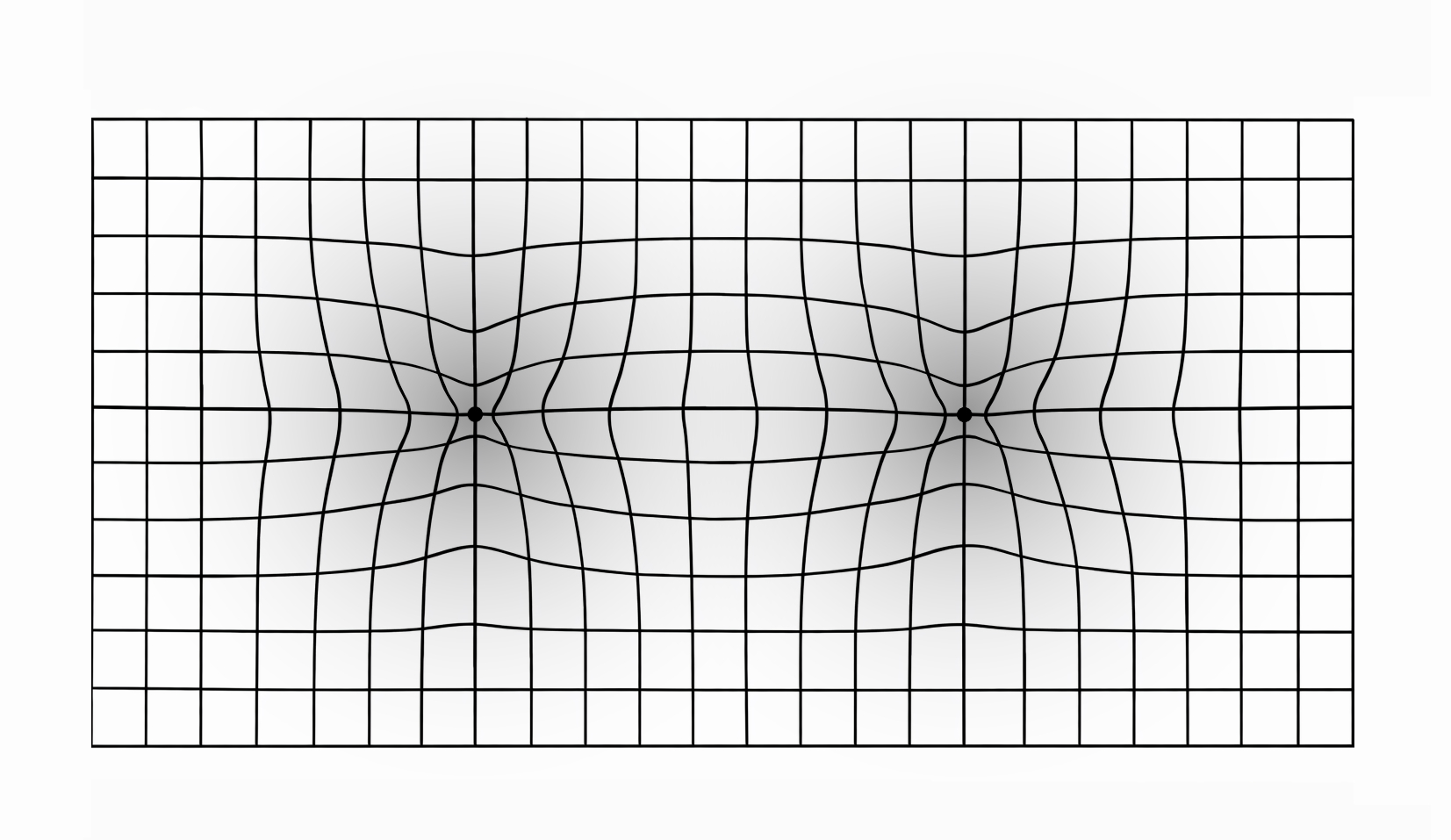
As multiple manifestations coexist, their underlying causal organizations become integrated within one continuous field of relational continuity. Large-scale matter distributions, orbital systems, accretion processes, and cosmological structures express successive stages of this cumulative causal organization. Gravity reconstructs the geometric expression of these integrated causal configurations throughout Manifestation. Interpreted through the ontological architecture of TEMTC, gravitational order reflects increasing degrees of causal coherence. Regions exhibiting greater relational integration organize the surrounding causal field with correspondingly greater structural stability. These organized gradients condition the subsequent development of Manifestation, giving rise to the large-scale geometric regularities described by General Relativity. What physical theory characterizes mathematically as gravitational attraction is localized ontologically as the articulation of causal continuity through Manifestation.
TEMTC interprets gravitational geometry as the manifested articulation of Formative Causality. Curvature, metric relations, and large-scale gravitational structure constitute successive expressions of one continuous causal organization. In doing so, TEMTC preserves the mathematical framework established by General Relativity while localizing it within the broader ontological architecture of Meta-Para-Ontology.
2.3 Emergence of Space and Time
Space and time are reconstructed by TEMTC as co-emergent dimensions acquiring stable metric structure through Manifestation. They arise together as complementary expressions of an underlying causal continuity becoming articulated. Their coordinate framework belongs to Manifestation itself, accompanying the transition through which causal continuity acquires determinate physical expression. Space reconstructs the relational structure of manifested configurations, providing the framework through which physical entities become localized. Spatial distance expresses the geometric articulation of these underlying causal relations once they acquire stable manifestation. Time reconstructs the ordered continuity through which this articulation unfolds, expressing the succession by which manifested configurations arise, stabilize, transform, and give way to subsequent configurations. Spatial extension and temporal succession therefore constitute complementary aspects of one continuous process through which causal continuity becomes physically structured.
Ontologically, space and time belong entirely to Manifestation as its intrinsic coordinate structures. Their emergence presupposes the coordinate of observation through which Manifestation becomes measurable, intelligible, and experientially accessible. Observation designates the ontological function of Manifestation encompassing every participating center through which reality becomes articulated as experience, including biological, psychological, and other possible modes of conscious life. The universe is consequently understood as the ordered articulation of causal continuity whose spatial and temporal geometry belongs to Manifestation itself. Metric space and temporal order express the observable realization of this continuity, marking the transition through which causal continuity becomes physically measurable and experientially accessible.
2.4 Convergence with General Relativity
General Relativity provides an accurate reconstruction of the geometry of Manifestation. It describes the structural articulation of spacetime once causal relations acquire stable metric expression. From the standpoint of Meta-Para-Ontology, General Relativity localizes the geometry of Manifestation itself, where spacetime appears as the ordered articulation of causal continuity expressing the relational structure through which stabilized configurations become geometrically observable. TEMTC interprets the curvature described by Einstein’s equations as the manifested expression of this distributed causal continuity. Every manifested configuration expresses a localized articulation whose collective integration generates the large-scale geometry described by General Relativity. Ontologically, Einstein’s mathematical description captures the geometric expression of an underlying causal continuity. TEMTC reconstructs the conditions under which this geometric articulation becomes possible.
2.5 From Causal Tension to Metric Geometry
Gravity emerges within TEMTC as the observable expression of structural tension intrinsic to causal organization. Its physical dynamics become localized at the transition through which Formative Causality acquires stable metric expression within Manifestation. As this causal continuity becomes integrated, the surrounding causal field undergoes a corresponding concentration of relational constraints. Greater structural coherence corresponds to increasing causal integration, generating the structural tension whose geometric expression becomes observable as gravity.
In the ontological interpretation developed by TEMTC, inertial and gravitational mass express complementary aspects of one underlying causal coherence manifested within Manifestation. Inertial mass characterizes the persistence of an established causal configuration under conditions of transformation; gravitational mass describes the relational integration through which that same configuration participates in the surrounding causal field. Their empirically established numerical equivalence is localized as the expression of one continuous causal architecture articulated through two complementary perspectives of physical observation. TEMTC reconstructs this relation within the coordinate architecture of Meta-Para-Ontology as the ontological expression of a unified causal architecture. Gravity is thus understood as the geometric signature of the structural tension intrinsic to causal organization. Increasing structural complexity entails increasing requirements for relational coherence across the causal field. Informational pressure designates this growing demand for systemic integration operating prior to and throughout Manifestation. Gravitational dynamics express the cumulative stabilization of these relations, providing the observable geometric signature through which causal continuity maintains coherence throughout continual transformation.
Chapter 3. Quantum Mechanics and the Threshold of Manifestation
Mapped onto the coordinate architecture of TEMTC, quantum mechanics occupies a precisely localized position. It characterizes the threshold at which Formative Causality becomes articulated through Manifestation, describing the transition where causal continuity first acquires observable expression prior to its stabilization into determinate spacetime geometry. Quantum theory therefore reconstructs neither the ultimate ontological foundation of reality nor a reduced microphysical approximation of classical physics. Its formalism localizes the structural conditions under which causal continuity becomes physically observable while preserving causal underdetermination within the relational field.
3.1 Quantum Theory and the Conditions of Observability
Viewed through the ontological architecture of TEMTC, quantum mechanics reconstructs the conditions under which reality becomes observable. Its mathematical formalism describes the structural conditions through which determinate physical reality becomes accessible as observation, extending beyond the description of microscopic particles and probabilistic outcomes toward the conditions governing manifestation itself. Physical quantities acquire determinate values only within the conditions defining their manifestation, a feature already embedded within the formal architecture of quantum theory. Contextuality expresses the ontological threshold at which causal continuity first becomes articulated as observable reality. Quantum theory characterizes the transition through which determinate physical appearance becomes possible, uncovering the structural conditions preceding any completed physical world.
Prior to stable Manifestation, causal organization persists as a coherent system of relational constraints whose possible developments remain structurally ordered without yet acquiring determinate physical realization. Observation functions as an ontological coordinate intrinsic to Manifestation itself, operating independently of any external intervention by a human observer. The observer expresses the structural condition through which causal continuity becomes physically articulated, localizing the transition from relational structure to determinate physical appearance. This localization avoids both instrumental reductionism and subjective idealism, preserving the operational precision of quantum theory. Preparation procedures, measurement contexts, and the mathematical formalism of quantum measurement developed by von Neumann\footcite{vonNeumann1932}, together with the Born rule\footcite{Born1926}, specify the formal conditions governing this articulation, localizing the quantum formalism precisely at the ontological boundary where Formative Causality first becomes physically accessible.
3.2 Indeterminacy and Causal Underdetermination
Within the coordinate architecture of TEMTC, quantum indeterminacy reconstructs the causal organization characteristic of the threshold preceding stable Manifestation. It expresses a condition of causal underdetermination in which relational constraints define the structured space of possible developments without selecting a unique physical realization. Quantum probabilities therefore reconstruct the intrinsic openness of Formative Causality, localizing the degree to which causal continuity remains unresolved prior to manifested articulation. Indeterminacy expresses a stage at which causal continuity has already established coherent relational constraints, leaving the articulation of one determinate manifestation incomplete.
Before stable Manifestation emerges, Formative Causality organizes possibilities without fixing their completed realization. Relational configurations establish coherent constraints governing future development, preserving multiple compatible trajectories through which manifestation may occur. Probability expresses this structured openness as an intrinsic property of the formative process itself. Measurement completes an ongoing process of causal articulation by stabilizing one determinate manifestation from an already coherent relational field. The operational structure of quantum mechanics thereby reconstructs the transition through which causal organization becomes physically determinate. It localizes the passage from formative relational continuity to manifested physical structure within the deeper ontological architecture reconstructed by TEMTC.
3.3 Superposition and Nonlocality
Quantum superposition reconstructs the organization of causal configurations prior to stable differentiation within Manifestation. Multiple compatible outcomes remain integrated within one relational structure because the process of causal articulation has not yet converged upon a single manifested configuration. Superposition thus expresses the coherence of an underdetermined causal continuity, preserving a unified relational structure throughout the process by which manifestation becomes determinate. The same ontological continuity is expressed through quantum nonlocality when viewed from the standpoint of relations connecting manifested systems. Entangled configurations preserve a common causal continuity originating in Formative Causality, allowing correlated structures to remain integrated prior to complete differentiation within Manifestation. The observed correlations express the continuity of one underlying causal field articulated across multiple manifested configurations. Spatial separation itself belongs entirely to Manifestation. Causal continuity precedes the emergence of spatial coordinates and subsequently becomes articulated through them. Relations appearing nonlocal within spacetime reconstruct a pre-spatial causal continuity whose coherence remains independent of geometric distance. Superposition and nonlocality consequently represent complementary expressions of one continuous causal process localized at the ontological threshold where Formative Causality acquires manifested articulation.
3.4 Collapse as Entry into Manifestation
Wavefunction collapse, within the ontological architecture of TEMTC, marks the transition through which an underdetermined causal organization becomes articulated as a determinate manifested configuration. This transition localizes the passage from Formative Causality into Manifestation, where relational structure acquires stable physical, temporal, and experiential expression. The discrete character of collapse reflects the manner in which Manifestation stabilizes observable configurations, preserving the underlying causal continuity across the transition. Collapse therefore expresses the completion of causal articulation itself. A relational configuration previously existing as a coherent field of compatible possibilities acquires the stability of a determinate manifested event. This transition simultaneously anchors the configuration within the causal field, renders it accessible to observation and experience, and integrates it into the ongoing continuity through which subsequent manifestations become possible. The operational formalism of quantum mechanics captures these conditions with remarkable precision. Schrödinger evolution\footcite{Schrodinger1926} describes the continuous development of underdetermined causal continuity. In turn, measurement localizes the threshold at which this continuity acquires determinate manifestation. TEMTC reconstructs these complementary aspects as successive phases of one continuous ontological process linking Formative Causality with Manifestation.
3.5 Why Quantum Theory Cannot Replace Ontology
Quantum mechanics describes reality within a precisely localized ontological domain. Its formalism describes the conditions under which causal continuity becomes observable, measurable, and physically articulated through Manifestation. Observation, determinacy, causal articulation, and manifested coherence accordingly appear as structural presuppositions governing the domain described by quantum theory. TEMTC localizes these presuppositions within its broader coordinate architecture. Formative Causality establishes the continuity through which relational configurations develop, and Manifestation articulates the realization of that continuity as determinate physical reality. Quantum mechanics faithfully describes the threshold connecting these two registers, preserving its explanatory integrity while localizing its proper scope. Ontology reconstructs the conditions through which physical theories become possible. From the standpoint of this coordinate framework, quantum mechanics and General Relativity appear as complementary descriptions of successive stages within one continuous causal process. Quantum theory describes causal articulation approaching Manifestation, whereas General Relativity characterizes the stabilized geometry through which Manifestation becomes physically articulated. TEMTC integrates both theories within one coherent coordinate architecture while preserving the formal integrity of each.
Chapter 4. Cosmology, Information, and the Limits of Physical Explanation
At its largest observable scale, cosmology occupies the natural point at which physical description becomes amenable to ontological reconstruction. Quantum mechanics localizes the threshold through which causal organization first becomes physically articulated. In turn, General Relativity characterizes the stable geometry arising from this articulation within Manifestation. Cosmology extends these complementary descriptions toward the universe as an integrated whole. In doing so, it occupies a distinctive conceptual position. Unlike every other branch of physics, cosmology cannot situate its object within a broader physical environment, nor can it describe the universe from an external observational standpoint. Every cosmological description proceeds from the very manifested reality it seeks to explain, employing only the coordinate structures established by Manifestation itself. This unique epistemological situation admits a natural ontological interpretation. Cosmology describes the large-scale articulation of Manifestation, approaching its earliest physically accessible conditions, where physical investigation encounters the emergence of metric reality. It thus occupies the natural point of convergence between physical description and ontological reconstruction, providing the transition from the observable geometry of Manifestation toward the deeper causal continuity reconstructed by Meta-Para-Ontology.
4.1 Cosmology and the Problem of Origins
Modern cosmology describes the large-scale evolution of the observable universe with extraordinary precision. As this description approaches the earliest physically accessible stages of cosmic evolution, it simultaneously reaches the boundary conditions governing the emergence of metric geometry itself. TEMTC interprets cosmological singularities as precisely this ontological frontier. They identify the limiting condition at which the physical description of spacetime reaches the boundary of its proper explanatory domain, corresponding structurally to the transition between Meta-Potentiality and the earliest organization of Formative Causality. Metric geometry therefore appears as an emergent organization whose articulation begins only after the underlying causal field has acquired sufficient structural coherence. From the standpoint of TEMTC, whatever cosmological model successfully describes the earliest physically accessible stage of cosmic evolution localizes the earliest stage of Manifestation. Within contemporary cosmology, this role is conventionally assigned to the Big Bang model. In this interpretation, the Big Bang designates the articulation through which the openness of Meta-Potentiality becomes organized within Formative Causality and subsequently acquires stable metric expression through Manifestation. Cosmology thereby describes the earliest observable articulation of metric reality, while ontology reconstructs the conditions through which such metric reality becomes possible.
4.2 Cosmological Time and the Illusion of a Universal Clock
Standard cosmological models describe time as a global parameter extending from the Big Bang to the present. General Relativity, however, makes such a global temporal coordinate available only under specific symmetry conditions, most notably in homogeneous and isotropic FLRW cosmologies, where cosmic time corresponds to the proper time of comoving observers.\footcite{Ryden2017} TEMTC assigns this reconstruction a broader ontological significance. As established in the preceding section, time belongs to Manifestation as an emergent coordinate arising from the ordered articulation of causal continuity. Cosmological time therefore represents a large-scale abstraction reflecting the coordinated development of manifested structures across the observable universe.
The apparent directionality of time likewise admits an ontological interpretation. The arrow of time expresses the cumulative stabilization of causal continuity as more coherent configurations become articulated throughout Manifestation. Each successive stage incorporates prior configurations into an expanding relational structure, providing the ordered continuity through which subsequent manifestations become possible. Entropy likewise receives a corresponding ontological interpretation. Its increase reflects the growing stabilization and differentiation of manifested structures as causal continuity becomes articulated throughout Manifestation.
When cosmology reconstructs the early universe, it localizes the earliest physically observable stage of this emergent temporal order. This designation refers to a regime in which metric structure had only begun to stabilize through Manifestation. Cosmological time therefore characterizes the observable ordering of manifested reality as an emergent coordinate of Manifestation. The universal cosmic clock employed by relativistic cosmology consequently appears as an emergent coordinate whose large-scale regularity reflects the coherence of the underlying causal continuity.
4.3 The Universe as an Articulated Process
TEMTC interprets the universe as a continuously articulated process of causal continuity, displacing the classical image of a self-contained object situated within a pre-established spacetime framework. Cosmology thereby localizes the observable development of Manifestation itself, where the apparent unity of the cosmos emerges through the progressive stabilization of causal relations. General Relativity describes this articulated reality through the geometry of spacetime. From the standpoint of TEMTC, this geometry localizes the stabilized structure of Manifestation after causal continuity has acquired determinate metric expression. The observable coherence of the universe reflects the progressive stabilization of relational structures whose deeper unity originates in Formative Causality and becomes physically articulated through Manifestation.
This perspective naturally reinterprets several longstanding cosmological questions. Physical causality governs relations operating within Manifestation. The transition through which Manifestation itself becomes possible belongs to the deeper coordinate architecture reconstructed by TEMTC. The emergence of the observable universe corresponds to the transition by which Formative Causality acquires stable manifestation. That transition simultaneously establishes the invariant coordinate of observation intrinsic to Manifestation—the structural condition through which causal continuity becomes physically articulated as an observable world. The cosmological origin consequently designates the earliest articulation of Manifestation and the emergence of the observable temporal order discussed above. Cosmology reconstructs the observable history of this unfolding; ontology reconstructs the conditions that render it possible.
4.4 Dark Matter as Sub-Manifest Causal Structure
The same ontological reconstruction naturally extends to cosmological phenomena that participate in gravitational dynamics without acquiring corresponding observable manifestation. The problem of dark matter therefore receives a natural localization within the coordinate architecture of Meta-Para-Ontology, fully preserving the empirical reconstruction established by contemporary cosmology. Observations consistently indicate gravitational effects exceeding those attributable to observable matter alone, leading modern cosmology to reconstruct an additional component contributing to the dynamics of galaxies and large-scale cosmic structure. TEMTC preserves this entire empirical picture. Its contribution consists exclusively in reconstructing the ontological conditions through which such gravitational behavior becomes intelligible.
TEMTC localizes this discrepancy ontologically. Configurations within Formative Causality participate in the generation of gravitational geometry without crossing the threshold required for stable material localization. They contribute to the relational organization underlying gravitational coherence without acquiring the degree of articulation required for ordinary material manifestation. This interpretation preserves the empirical descriptions established by contemporary cosmology and situates the phenomenon within the broader ontological architecture reconstructed by TEMTC.
4.5 Manifestation and Inversion of Manifestation: Black Holes
Figure 2 provides a heuristic representation of the threshold of Manifestation within the coordinate architecture of TEMTC. It illustrates manifested entities as localized regions of stable causal articulation embedded within the continuous field of Formative Causality. These configurations constitute coherent patterns of relational continuity whose interaction generates the conditions through which subsequent manifestations become possible.
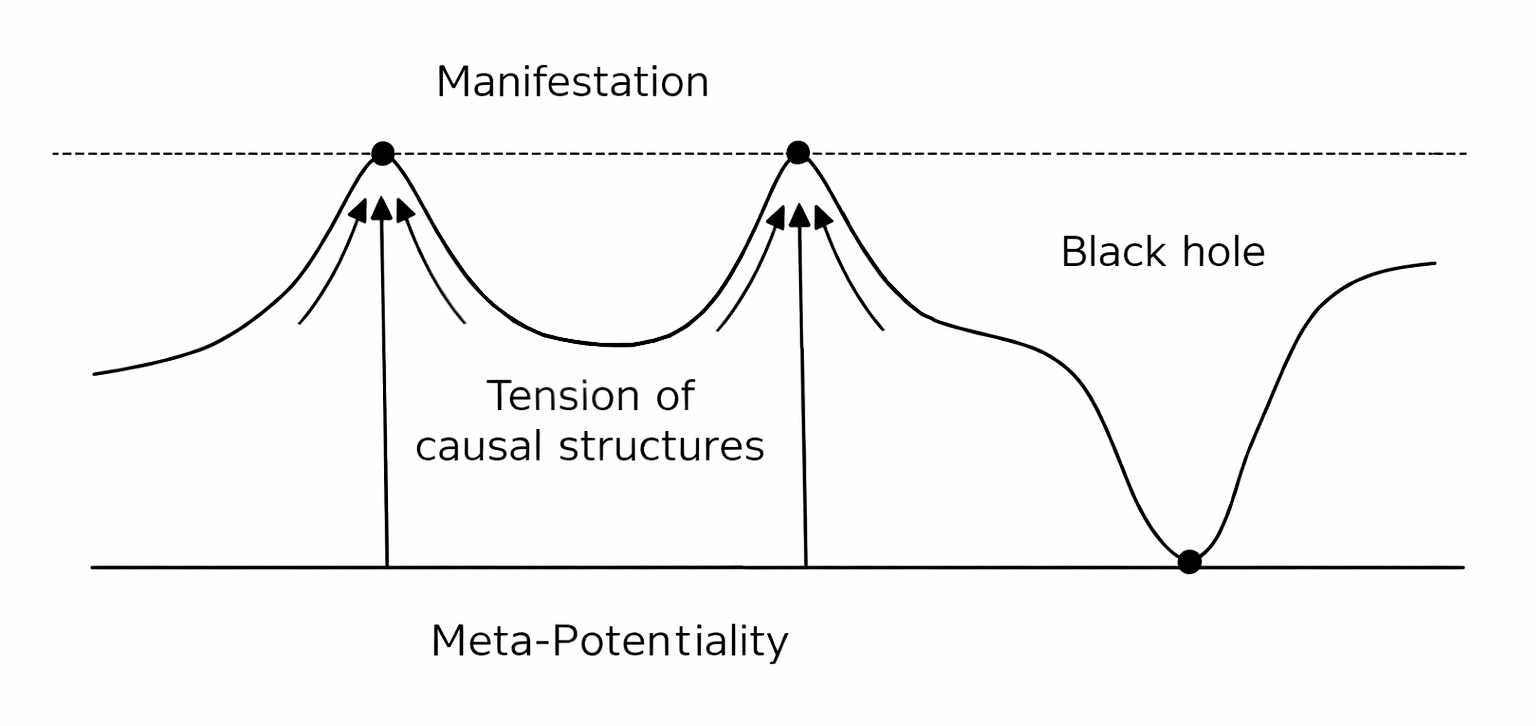
Situated at the extreme limits of physical articulation, black holes provide a particularly significant case for ontological localization. Contemporary astrophysics reconstructs these phenomena through the geometry of spacetime, describing event horizons, extreme curvature, and the singular limits of General Relativity. TEMTC preserves these physical reconstructions without modification, providing a coordinate framework through which their limiting behavior may be interpreted. Seen through this coordinate system, the geometric boundaries reconstructed by General Relativity admit interpretation as possible thresholds separating different modes of causal articulation. The phenomenology of black holes thus becomes a privileged point of ontological localization within the TEMTC framework. At the event horizon and, more fundamentally, at the singular limit predicted by classical General Relativity, physical description encounters the boundary of its own explanatory domain. TEMTC interprets this limiting behavior as identifying the point at which the structure reconstructed by physical geometry reaches the boundary of Manifestation itself. This localization provides the ontological criteria through which alternative physical descriptions of black hole interiors may be understood.
Accordingly, TEMTC introduces no independent physical model of black hole interiors. It establishes a conditional ontological classification. If future physical theories ultimately demonstrate that spacetime geometry, physical observables, and determinate causal structure terminate at the singular limit, this limiting case may be understood as marking the exhaustion of Manifestation together with the collapse of the formative continuity sustaining it. Within this coordinate architecture, the singular limit may designate the comprehensive collapse of metric structure and the articulated continuity of Formative Causality itself, returning the entire causal configuration to the undifferentiated openness of Meta-Potentiality. If, alternatively, future developments in quantum gravity or related approaches demonstrate the persistence of pre-metric causal continuity beyond the limits of classical spacetime, TEMTC localizes such structures within Formative Causality, interpreting them as extreme causal configurations whose articulation precedes stable metric realization.
Singular behavior therefore identifies the exact limit at which physical reconstruction requires ontological localization. TEMTC consequently functions as a coordinate architecture capable of classifying future physical developments without prescribing their empirical content. The event horizon and the singular limit thereby serve as structural markers indicating where physical description reaches the boundary of Manifestation and where the deeper causal continuity reconstructed by Meta-Para-Ontology may become relevant.
4.6 The Limits of Physical Explanation
Physical explanation ultimately reaches a structural limit regarding the conditions through which reality itself becomes possible. Questions concerning the origin of causal organization, the conditions of Manifestation, and the openness from which structured reality emerges belong exclusively to the domain of ontology. This limitation clarifies the proper scope of physical explanation. Physics reconstructs the organization of reality once causal structures become accessible to empirical observation and mathematical description. The conditions through which causality itself becomes organized necessarily remain beyond the methodological horizon of physical theory. As physics approaches this frontier, it naturally develops conceptual extrapolations—including quantum vacuum fluctuations, quantum foam, multiverse scenarios, and informational substrates. Interpreted through the coordinate architecture of TEMTC, these constructs function as heuristic indicators pointing toward questions situated beyond the formal explanatory domain of physics. They serve strictly as boundary markers designating the limits of physical extrapolation.
TEMTC provides the coordinate architecture within which these explanatory domains become systematically integrated without reducing ontology to physics or physics to metaphysics. Its architecture is articulated through three primary registers:
- Meta-Potentiality grounds the openness through which structured reality becomes possible.
- Formative Causality organizes the continuity of causal relations.
- Manifestation articulates causal organization as observable physical reality.
Cosmology reconstructs Manifestation at its largest coherent scale. Ontology clarifies the conditions through which Manifestation itself becomes possible.
Chapter 5. Why Reality Is Not Computable
TEMTC localizes computation within a limited domain of reality. Every computational system presupposes stable states, fixed transformation rules, and determinate relations before computation can begin. Formative Causality constitutes a fundamentally different mode of causal continuity. It operates as a continuously developing causal field through which structural relations, constraints, and transformation rules themselves become articulated. Because the conditions governing Manifestation remain intrinsically generative, no finite algorithm can exhaustively account for their complete development. Computation presupposes a level of stability that Formative Causality is still in the process of producing. Quantum mechanics provides an important physical localization of this limitation. Its formalism successfully describes the statistical structure of observation, measurement, and probabilistic outcomes, while individual manifested events remain irreducible to deterministic algorithmic prediction. Within TEMTC, this indeterminacy reflects the openness characteristic of Formative Causality prior to stable Manifestation. Algorithms describe determinate structures; they cannot account for causal continuity whose own structure is still becoming determinate. The same limitation appears more generally in the relation between computation and ontology. Formative Causality describes a continuous relational architecture in which memory, relational structure, and causal constraints develop together, each conditioning the others. Every formal system requires stable parameters before computation can begin. Formative Causality describes the process through which those parameters themselves become established. The ground is still being formed; computation requires it to be already fixed. Computational models accordingly describe stabilized structures of Manifestation without capturing the generative continuity from which such stability emerges.
Digital universe hypotheses and computational cosmologies capture an important aspect of reality. Rule-based architectures, informational networks, and computational descriptions successfully describe genuine dimensions of causal continuity. Their limitation arises only when computation itself is identified as the ultimate foundation of reality. TEMTC instead localizes computation within the broader continuity of Formative Causality, interpreting algorithmic structure as one legitimate expression of a deeper causal architecture rather than its ontological ground. Physics describes reality once causal continuity has become sufficiently stable to admit mathematical description. Ontology clarifies the conditions through which such stability becomes possible. Computational description constitutes one valid mode of describing reality, localized within Manifestation. TEMTC reconstructs the broader causal continuity through which computationally expressible structures themselves become possible.
Chapter 6. Freedom, Determination, and the Limits of Physical Law
Freedom and determination reconstruct complementary ontological dimensions of one continuous causal organization. Determination emerges where relations acquire sufficient coherence to stabilize as persistent structures within Manifestation. Freedom corresponds to the openness preserved throughout Formative Causality, where multiple coherent articulations remain possible prior to stable realization. The source of this openness belongs to Meta-Potentiality. Because Meta-Potentiality remains irreducible to every determinate articulation, Formative Causality develops as an intrinsically open causal field. Its relational configurations organize genuine constraints while preserving the capacity for further differentiation. Freedom thus expresses the continued presence of unrealized possibilities grounded in Meta-Potentiality, affirming an intrinsic structural openness.
Physical laws describe the structure of reality exclusively after causal structures have achieved stable realization within Manifestation. Their explanatory scope remains intrinsically localized to already established structures. Physics explains how stabilized configurations evolve under determinate laws; the emergence of those configurations belongs to the formative process articulated by Formative Causality. Determinism in its ordinary physical sense—defined by a fixed state space, explicit dynamical laws, and appropriate initial conditions—accordingly applies only within already established regimes of Manifestation. The process through which such regimes emerge precedes this form of physical determinism. TEMTC reconstructs this process as the progressive articulation of causal relations before their stabilization within Manifestation. Physical law thus appears as the manifested expression of a deeper causal continuity whose realization precedes stable metric structure.
Freedom constitutes an ontological condition, distinct from any mere psychological or metaphysical exception. It expresses the openness through which causal continuity differentiates itself into articulated structures, preserving multiple coherent configurations before convergence upon stable Manifestation. Determination corresponds to the completion of this process as causal continuity acquires persistent relational coherence. The limits of physical law identify the proper boundary of physical explanation. Physics describes manifested reality once stable causal articulation has become observable and mathematically describable. Ontology reconstructs the conditions through which this articulation becomes possible. Freedom and determination consequently appear as complementary phases within one continuous causal organization: freedom preserves the openness of causal articulation; determination expresses its stabilization within Manifestation.
Conclusion: Toward a Coherent Ontology of Physical Reality
The present study has established the ontological conditions underlying physical reality through the coordinate architecture of Meta-Para-Ontology. Its primary objective has been to localize the respective domains of existing physical theories within a unified coordinate framework. The Theory of Emergent Metric Tension in Causality (TEMTC) demonstrates that quantum mechanics and General Relativity occupy complementary positions within one continuous causal organization, each remaining fully valid within the domain it describes. Seen through this architecture, the long-standing tension between the two theories no longer reflects an incompatibility between competing descriptions of reality. It reflects successive stages within one continuous process of causal articulation. Quantum mechanics localizes the threshold through which causal continuity first becomes physically articulated. In turn, General Relativity characterizes the stabilized geometry emerging from this process. Their apparent incompatibility results from placing both theories within the same ontological level despite occupying different positions within the broader architecture of Manifestation.
This ontological localization correspondingly clarifies several foundational problems across contemporary physics. Quantum measurement describes the transition through which underdetermined causal continuity becomes manifested as determinate physical reality. Probability expresses the openness preserved within Formative Causality prior to stable articulation. Spacetime articulates the observable geometry generated through causal continuity, expressing a manifest structure distinct from any independently existing background. Gravity expresses the manifested coherence of causal continuity. Cosmology reconstructs the large-scale evolution of Manifestation as it approaches the conditions governing its own emergence. These interpretations preserve the explanatory integrity of contemporary physics while clarifying the ontological conditions under which its mathematical descriptions become possible.
Throughout this investigation, Meta-Para-Ontology has functioned strictly as an ontological framework, distinct from any alternative physical theory. The empirical content, mathematical formalisms, and methodological integrity of contemporary physics remain fully preserved. Ontology reconstructs the conditions through which physical descriptions become mutually intelligible; physics describes Manifestation once causal continuity has acquired stable, observable, and mathematically expressible form. The two disciplines thus occupy complementary explanatory domains within one continuous coordinate architecture. In this sense, TEMTC serves as an internal validation of the architectural coherence of Meta-Para-Ontology, demonstrating that its primary registers remain conceptually consistent when applied to the most demanding foundational problems of modern physics.
The present investigation addresses only one region of the broader architectonic structure of Meta-Para-Ontology. Beyond the registers of Meta-Potentiality, Formative Causality, and Manifestation, the complete ontology extends toward Meta-Actualization, where meaning, value, self-reflection, and existential orientation emerge as higher articulations of the same structural continuity. Physical reality occupies one coordinated domain within a considerably broader philosophical architecture. Within this architecture, Meta-Potentiality grounds ontological openness, Formative Causality organizes relational continuity, and Manifestation realizes that continuity as observable physical reality. Causality precedes geometry, relational continuity precedes metric structure, and physical reality emerges as the stable realization of an underlying generative order. The apparent fragmentation of contemporary physics consequently appears as the natural consequence of describing different ontological registers through distinct yet complementary theoretical frameworks.
Bibliography
Born, Max. “Zur Quantenmechanik der Stoßvorgänge.” Zeitschrift für Physik 37, no. 12 (1926): 863–867. https://doi.org/10.1007/BF01397477.
Burgess, C. P. “Quantum Gravity in Everyday Life: General Relativity as an Effective Field Theory.” Living Reviews in Relativity 7, no. 5 (2004).
Donoghue, John F. “General Relativity as an Effective Field Theory: The Leading Quantum Corrections.” Physical Review D 50, no. 6 (1994): 3874–3888.
Einstein, Albert. “Die Grundlage der allgemeinen Relativitätstheorie.” Annalen der Physik 354, no. 7 (1916): 769–822.
Goroff, M. H., and A. Sagnotti. “Quantum Gravity at Two Loops.” Physics Letters B 160, nos. 1–3 (1985): 81–86.
Neumann, John von. Mathematische Grundlagen der Quantenmechanik. Berlin: Julius Springer, 1932.
Ryden, Barbara. Introduction to Cosmology. 2nd ed. Cambridge: Cambridge University Press, 2017.
Schrödinger, Erwin. “Quantisierung als Eigenwertproblem.” Annalen der Physik 384, no. 4 (1926): 361–376. https://doi.org/10.1002/andp.19263840404.
Shapoval, Oleksandr. Meta-Para-Ontology: The Architecture of Reality Across Four Ontological Registers, 2026. https://doi.org/10.5281/zenodo.18524550.
Shapoval, Oleksandr. The Theory of Functional Configurations of Experience: A Triadic Code of Existence, 2026. https://doi.org/10.5281/zenodo.18596219.
‘t Hooft, G., and M. Veltman. “One-Loop Divergencies in the Theory of Gravitation.” Annales de l’Institut Henri Poincaré A 20, no. 1 (1974): 69–94.