Reality Configurations: Meta-Para-Ontology as a Meta-Level Theory of Everything
Reality can be represented through almost any geometric configuration: linearly, vertically, horizontally, cyclically, through grids, or through more complex spatial relationships. The choice of form does not, by itself, determine what reality is. It determines how a particular aspect of reality is represented and organized within a given system. Such representations often serve to simplify and organize complex ideas, giving them a visually intelligible and readily readable form through diagrams and schemes. Some visualizations, however, are not primarily intended to simplify their subject matter and may instead introduce additional layers of formal or conceptual complexity. The choice of representation therefore depends on the purpose it is meant to serve.
Some attempts to represent reality employ highly sophisticated mathematical or geometric configurations. String Theory makes use of additional dimensions and mathematical structures; Calabi–Yau manifolds provide complex geometric spaces within which physical models can be formulated; and the amplituhedron represents scattering amplitudes through a multidimensional geometric object in an abstract mathematical space. Ken Wilber’s Integral Philosophy uses a four-quadrant configuration to organize different dimensions of human experience and knowledge. Mystical traditions have developed their own symbolic geometries: mandalas, the Brahmanda or cosmic egg in Indian cosmology, and the Tree of Life in Jewish mysticism are only a few examples.
These forms of spatial and geometric representation can perform very different tasks in very different contexts. Their existence does not require them to exclude or replace one another. A geometric configuration may be exceptionally effective for expressing one aspect of reality, while another may disclose relations that the first does not represent in the same way.
This raises a more fundamental question: can any one geometric configuration constitute an exhaustive description of reality? If such a configuration cannot incorporate other legitimate forms of universal description, there is already a reason to question its claim to exhaustiveness. The problem becomes even clearer when one system cannot adequately account for why another universalist system or form of description exists at all. A description that achieves apparent universality by simply excluding competing descriptions has not demonstrated that it contains reality as a whole. It has established the scope of its own representation.
We are therefore left with multiple possible geometries of reality. Beyond geometry, there are still more forms of representation: philosophical systems, epistemological frameworks, religious cosmologies, metaphysical models, and other conceptual architectures. These systems themselves often acquire recognizable forms. They may be organized through sequences of principles, concentric relations, cycles, networks, or hierarchical orders. The visual form may vary, while the underlying organization of the system can remain precise and clearly defined.
This suggests a simple distinction. Form is a means of representation. Order and direction may be essential within a particular system because they determine how its elements are related and understood, but they do not automatically constitute universal principles of reality itself. A vertical representation does not become ontologically superior to a horizontal one simply because it is vertical. A circular representation does not become more fundamental because it has no apparent beginning or end. The form of representation should not be confused with the ontological structure of what it represents.
Let us now apply the same question about the representation of ideas and worldviews to philosophy itself. Do the many philosophical systems exist simply as a collection of positions dispersed across an undefined conceptual space, or can meaningful relations, orders, hierarchies, and structures be identified among them? Philosophy already has established divisions into fields and subfields, and these provide some degree of organization. Yet such classifications do not necessarily produce a unified relation among the different worldviews that philosophy contains. The question therefore remains whether a deeper order can be identified among them.
One form of such organization appears in the distinction between different orders of philosophical inquiry. Philosophical inquiry may concern reality, knowledge, ethics, mind, language, or other objects of investigation, while metaphilosophy turns the inquiry toward philosophy itself: its methods, concepts, assumptions, aims, and limits. Metaphilosophy is therefore often described as a second-order activity in relation to first-order philosophy. The distinction suggests that philosophical inquiry can become reflexive and take its own activity as an object of investigation.
This distinction does not by itself establish a universally accepted hierarchy within philosophy. Some philosophers resist treating first-order philosophy and metaphilosophy as higher and lower levels and instead understand them as different kinds of philosophical activity. Others use higher-order distinctions explicitly, allowing reflection upon metaphilosophy itself to generate further levels of inquiry. Morris Lazerowitz provides a particularly clear example of this recursive possibility. In his discussion of metaphilosophy, first-order philosophical activity is distinguished from metaphilosophical inquiry as a second-order activity. From there, an investigation of metaphilosophy itself could constitute a third-order philosophy, after which the process could continue indefinitely. His model therefore allows for a potentially endless succession of higher-order reflection.
What matters here is whether philosophy already contains a recognizable problem of order: philosophical systems can be distinguished according to what they investigate, how they investigate it, and whether they turn their own activity into an object of reflection. The same conceptual content can therefore be organized through different kinds of relations, and the resulting order depends partly on what is being examined.
This leads to the same conclusion that emerged from the discussion of geometric representations of reality. Philosophy itself can be organized and represented through different forms. The relations among philosophical systems may be arranged linearly, horizontally, vertically, cyclically, or through networks and other configurations. A hierarchy can therefore be useful in one context, while a horizontal map, a sequence, or a circular diagram may make other relations easier to perceive. The value of a representation depends on whether it makes the relations relevant to the purpose of inquiry clear and intelligible.

We are therefore not moving toward a universal theory of a single, universally valid geometry. Ideas may be expressed through vertical paradigms of evolution or involution, or arranged in a circle that represents both directions within a single configuration. Yet the same circle can also be unfolded into a linear representation, just as a globe can be unfolded into a flat map. The underlying knowledge can remain the same while its form of representation changes. Different forms may preserve different relations, directions, or boundaries, making some aspects more visible while altering or obscuring others.
The question is therefore one of adequacy. A representation does not have to reproduce everything in the same way. It has to preserve and clarify the relations that are essential to the system and relevant to the purpose of inquiry. A hierarchy, sequence, network, cycle, or other configuration can each serve this function in different contexts. None becomes intrinsically more true simply by virtue of its form.
But let us return to the central subject of what I explore here: Meta-Para-Ontology. If reality and philosophical systems can take many different forms of representation, why does Meta-Para-Ontology take the particular form that it does?
Meta-Para-Ontology is itself a constructed architecture. It consists of four ontological registers arranged in a linear order, and this specific configuration is an essential part of the system. Changing the number of registers, their relations, or the basic logic through which they are ordered would produce a different meta-system. This would not, in itself, make that alternative meta-system false or erroneous. It would simply mean that it constitutes a different architectural approach to describing reality. The fact that the architecture is constructed, however, does not mean that it is arbitrary, nor does it mean that reality itself must possess the same form.
The linear form of the four-register system is deliberate, but it is derived from the requirements of the task itself: to develop a sufficiently comprehensive architecture for the full range of ontological reality while remaining compatible with the plurality of existing theories and descriptions, including theories whose fundamental assumptions and conclusions may conflict with one another. The architecture is therefore designed to encompass different modes of existence, different levels of articulation, and fundamentally different forms of knowledge while remaining simple enough for their relations to remain intelligible. Its aim is to establish an architecture within which different descriptions can retain their own forms while becoming intelligible in relation to one another.
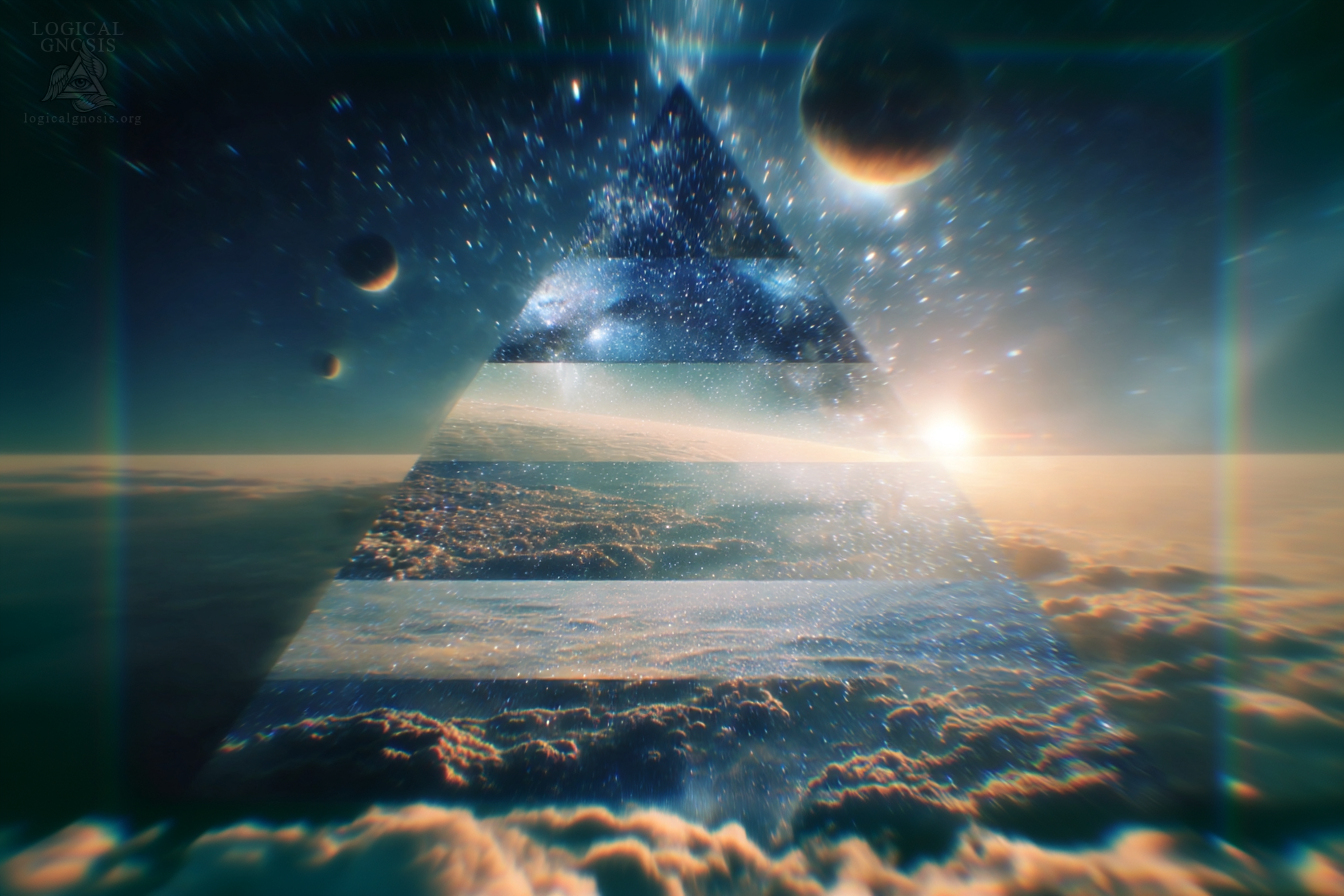
The registers function as ontological coordinates, identifying fundamental modes and transitions through which reality can be progressively distinguished and understood. Their linear order provides direction, distinction, and intelligibility within the architecture of MPO itself, while leaving the systems mapped within that architecture free to retain their own forms.
A circular, spherical, networked, or multidimensional representation may reveal relations that a linear architecture does not express in the same way. Such forms can therefore remain meaningful within the systems in which they operate. In the case of Meta-Para-Ontology, however, the four-register order serves a specific purpose: it makes the fundamental contour of the architecture readable through a small number of primary distinctions. Meta-Potentiality, Formative Causality, Manifestation, and Meta-Actualization identify four irreducible registers through which fundamental modes of ontological organization can be localized and understood. Their order represents their relations as ontological thresholds, while the continuous reality they articulate remains one unbroken field.
Meta-Para-Ontology begins with a small number of fundamental distinctions and develops its expressive capacity through the relations among them. The four registers provide the coordinate architecture, while Functional Ontology develops the internal dynamics of Manifestation through Recall, Differentiation, and Actualization. Polymetaphysical Cartography then applies the resulting architecture to philosophical, scientific, psychological, and metaphysical systems, allowing their internal structures to be reconstructed and localized without forcing them into a single vocabulary.
This also changes the significance of the different geometries discussed earlier. A circular cosmology does not have to become linear in order to be represented within MPO. A network does not have to become a hierarchy. A multidimensional mathematical model does not have to adopt the geometry of the four registers. These forms can retain their own configurations while acquiring a defined position within a broader architecture of relations. The philosophical and metaphysical systems may organize reality through cycles, emanations, oppositions, layers, processes, fields, networks, or other configurations. Their forms are part of what makes each system what it is.
By establishing a broader ontological architecture, Meta-Para-Ontology opens a common space in which fundamentally different forms of describing reality can coexist without being required to adopt a uniform geometry of description. Within this space, a cycle can remain a cycle, a hierarchy can remain a hierarchy, and a process can remain a process, while each can acquire a determinate relation to forms that organize reality differently. The four registers provide a stable coordinate architecture within which the plurality of reality-descriptions can remain plural. A mapped system can therefore become increasingly complex without requiring an ever-growing inventory of fundamental categories. The expressive complexity that Meta-Para-Ontology can represent arises primarily from the relations it can preserve and reconstruct, while the fundamental coordinates of the meta-architecture remain stable as the minimal necessary basis of the framework.
The same architecture can therefore be applied to philosophical systems whose forms, vocabularies, and fundamental assumptions differ radically from those of Meta-Para-Ontology itself. Through Functional Reconstruction and Polymetaphysical Cartography, systems such as General Systems Theory associated with Ludwig von Bertalanffy, Complexity Theory and Complex Thought associated with Edgar Morin, Integral Theory / AQAL developed by Ken Wilber, Process Philosophy associated with Alfred North Whitehead, Absolute Idealism associated with G.W.F. Hegel, Transcendental Idealism associated with Immanuel Kant, Phenomenology developed by Edmund Husserl, and Existential Ontology developed by Martin Heidegger can be reconstructed and localized within the broader ontological framework of MPO. Their internal concepts, relations, and distinctive forms of articulation remain identifiable, while their ontological scope and relations to other systems become available for systematic comparison. Such cartography establishes where their respective claims, categories, processes, and ontological commitments belong within a common architecture. In this sense, MPO provides a framework within which radically different philosophical forms can become simultaneously distinguishable, comparable, and intelligible. The resulting architecture addresses the problem of a Theory of Everything by raising it to a meta-level and proposing Meta-Para-Ontology as an architectural solution: a framework capable of relating diverse theories and their different descriptions of reality within a common ontological space.
The architecture can remain fixed while the range of forms, theories, relations, and conceptual structures that can be localized within it continues to expand. Register Ontology establishes the four-register contour. Functional Ontology develops the internal dynamics of Manifestation through Recall, Differentiation, and Actualization. Polymetaphysical Cartography then opens this architecture to the plurality of philosophical, scientific, psychological, and metaphysical systems through which reality is described.
What is required is an architecture sufficiently articulated to preserve differences of form while making their ontological relations expressible. Meta-Para-Ontology adopts its own definite form in order to make this possible. It establishes a coherent space in which the many forms through which reality is encountered, described, interpreted, and theorized can retain their own configurations while acquiring a determinate place and relation within a larger whole. Reality in its fullness, however, does not have to take the form of the four registers or be exhausted by them, or by any other geometry, form, or configuration. Meta-Para-Ontology is therefore one possible configuration of reality, capable of recognizing other configurations without exhausting reality itself, while giving it intelligibility and order.