
Philosophy has produced a remarkable diversity of ontological systems. Materialism, idealism, process philosophy, phenomenology, scientific naturalism, classical metaphysics, and the great philosophical traditions of India each describe reality through internally coherent conceptual architectures. Yet despite this diversity, philosophy still lacks a universal framework capable of explaining how these different ontologies relate to one another or why they can all describe reality while arriving at profoundly different conclusions.
Meta-Para-Ontology approaches this problem by shifting attention from competing descriptions of reality toward the structural conditions that make any coherent description of reality possible. As one of the two fundamental pillars of Meta-Para-Ontology, Register Ontology reconstructs the fundamental contour of ontology itself, while Functional Ontology explains how reality operates within that contour. Bypassing the classification of objects, substances, or metaphysical domains, Register Ontology identifies the universal modes through which reality becomes describable before any particular philosophy, scientific theory, or metaphysical system begins to populate that description with its own concepts.
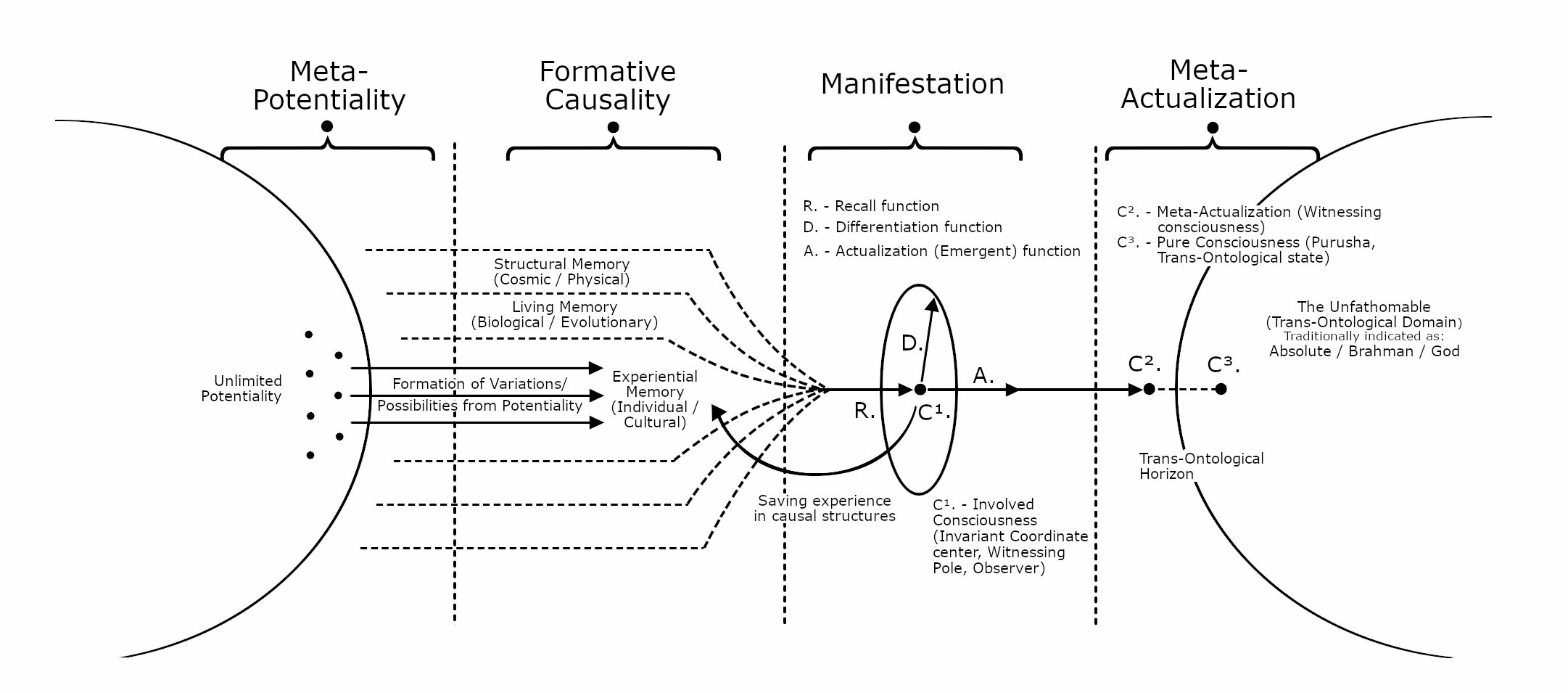
According to Register Ontology, every coherent description of reality necessarily unfolds through four irreducible ontological registers. Each register reconstructs a distinct mode of ontological articulation that remains structurally irreducible, as deriving it from the others would diminish the explanatory completeness of the framework. Together, they constitute the minimal complete contour through which ontology becomes possible. This four-register architecture emerges through the regressive reconstruction of the structural conditions required for any coherent ontology to become possible, entirely independent of arbitrary classification, historical convention, or metaphysical preference. Every register identifies an indispensable dimension of ontological articulation that enables the systematic localization of reality. Conversely, any proposal to introduce an additional register carries the burden of demonstrating a genuinely irreducible mode of ontological articulation, entirely distinct from a detailed subdivision of one already reconstructed within the existing framework. The four-register architecture therefore remains simultaneously minimal and complete: minimal because no register can be removed without diminishing explanatory scope, and complete because every further refinement can be accommodated within the same invariant ontological topology.
They are:
Meta-Potentiality — the register of pure openness preceding every determination.
Formative Causality — the register in which structure, limitation, and formative organization become possible.
Manifestation — the register of articulated, observable, and experiential reality.
Meta-Actualization — the register through which consciousness recognizes its irreducibility to Manifestation itself.
Together, these four registers reconstruct the complete contour of ontology—from undifferentiated openness to the point where ontology reaches its own legitimate boundary. Because they describe universal modes of articulation rather than particular entities or metaphysical doctrines, they remain invariant across every domain of inquiry. Scientific theories, philosophical systems, psychological models, and contemplative traditions may differ profoundly in their language, methods, and conclusions, yet they can all be structurally localized within the same ontological architecture.
Register Ontology therefore functions as the universal coordinate framework of Meta-Para-Ontology. It provides the stable ontological topology upon which Functional Ontology, Polymetaphysics, the Theory of Functional Configurations of Experience (TFCE), the Theory of Emergent Metric Tension in Causality (TEMTC), and every subsequent reconstruction are built.